English
The key difference between HDMI and HDMI AOC (Active Optical Cable) lies in the transmission medium and performance capabilities:
HDMI cables use copper conductors to transmit electrical signals.
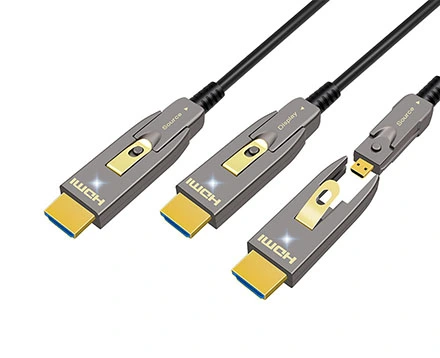
HDMI AOC uses a hybrid structure with optical fibers for high-speed TMDS (Transition Minimized Differential Signaling) channels and copper for low-speed signals and power, enabling longer transmission distances, lighter weight, and improved EMI resistance.
For professional AV integrators, high-end display manufacturers, and large-scale installation projects, this distinction affects not only the signal quality but also the feasibility of deployment in complex environments.
HDMI (Copper): Relies entirely on copper wires. While cost-effective, copper suffers from high attenuation and signal degradation over distance. Standard HDMI 2.1 copper cables typically perform reliably up to 3–5 meters at 48 Gbps.
HDMI AOC: Uses optical fibers to transmit high-bandwidth video data and copper wires for control signals and power. Optical fiber’s low attenuation allows HDMI AOC to maintain full 48 Gbps performance at lengths up to 150 meters or more without signal boosters.
Both HDMI and HDMI AOC can support the latest HDMI 2.1 specifications — including 4K@120Hz and 8K@60Hz — if properly designed.
However:
Copper HDMI: Maintaining maximum bandwidth over long distances is challenging due to signal loss and interference.
HDMI AOC: Optical fiber maintains consistent bandwidth over much longer runs, ensuring stable transmission for ultra-high-resolution and high-refresh-rate content.
Copper HDMI: Susceptible to EMI, which can cause sparkles, dropouts, or complete signal failure, especially in electrically noisy environments (factories, server rooms, control centers).
HDMI AOC: Immune to EMI for the optical signal portion, making it ideal for mission-critical AV installations in areas with high electrical interference.
Copper HDMI: Generally thicker and heavier at longer lengths. Cable bending radius is limited due to shielding and conductor size.
HDMI AOC: Slimmer, lighter, and more flexible, simplifying cable routing through conduits and tight spaces — a major advantage for large venue or concealed installations.
HDMI AOC integrates optical transceivers within the connector heads, powered by the +5V pin of the HDMI interface. Some high-performance models require additional power for enhanced stability.
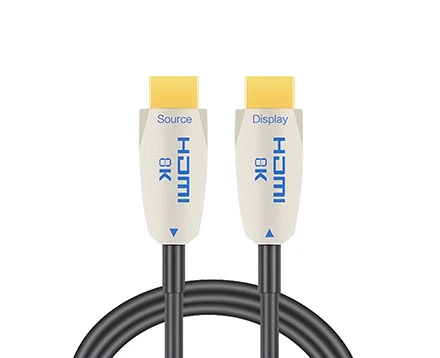
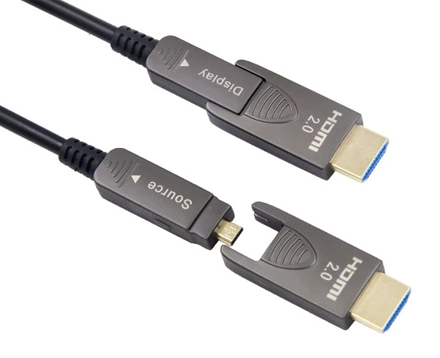
Signal conversion inside HDMI AOC is directional — the cable ends are labeled "Source" and "Display" — unlike copper HDMI, which is passive and bidirectional.
For short-distance consumer use (e.g., connecting a Blu-ray player to a TV in the living room), copper HDMI is often sufficient.
For B2B applications such as:
LED display walls in exhibition halls
Medical imaging systems
Broadcast production studios
High-end home theater integrator projects
HDMI AOC ensures long-term reliability and signal integrity, reducing maintenance and downtime.
Copper HDMI: Lower initial cost, but may require additional boosters, extenders, or replacements for long runs.
HDMI AOC: Higher upfront investment, but lower long-term cost in large-scale projects due to reduced signal troubleshooting and infrastructure changes.
| Feature | HDMI (Copper) | HDMI AOC (Active Optical Cable) |
Transmission Medium | Copper | Optical fiber + copper hybrid |
Max Reliable Length | 5m @ 48 Gbps | 150m+ @ 48 Gbps |
EMI Resistance | Low | Very high |
Weight & Flexibility | Heavy, less flexible | Lightweight, highly flexible |
Directionality | Bidirectional (passive) | Unidirectional (active) |
Ideal Use Case | Short consumer connections | Professional, long-distance installations |
The choice between HDMI and HDMI AOC ultimately depends on transmission distance, installation environment, performance requirements and also budget. In the B2B sector, especially for large-scale, high-resolution AV systems, HDMI AOC is becoming the industry standard due to its superior reach, EMI immunity, and ease of installation. But for game players, more and more are choosing our FHDC-2101S super slim 8K Fiber Optic HDMI Cable for its high performance and elegancy.
If your project involves 8K video walls, medical-grade imaging, or critical control room setups, investing in HDMI AOC is not just about performance — it's about ensuring flawless signal delivery for years to come.
AOC stands for Active Optical Cable. An HDMI AOC uses fiber optics and internal chipsets to transmit HDMI signals over longer distances with lower signal loss than traditional copper cables. Optical active HDMI cable solutions are widely used for 4K/8K AV systems, gaming, and commercial installations.
For long-distance transmission, yes. HDMI AOC provides more stable 4K/8K performance, better EMI resistance, and longer transmission distance compared with standard copper HDMI cables. An optical active HDMI cable is ideal for home theaters, LED displays, and conference rooms.
Yes. Most modern HDMI AOC cables support HDMI 2.1 features including 8K@60Hz, 4K@120Hz, HDR, eARC, and 48Gbps bandwidth. A high-quality optical active HDMI cable ensures reliable ultra-high-definition signal transmission.
Common HDMI AOC issues include signal loss, flickering, black screens, and directionality errors. Choosing certified optical active HDMI cable products and installing them correctly can prevent most problems.
Learn more here:
Common Problems With 8K HDMI Fiber Cables
Because an optical active HDMI cable contains active conversion chipsets, it must be installed in the correct direction. One connector is labeled “Source” and the other “Display.” Incorrect installation may cause no signal or screen flickering.
Last Updated: May, 2026 - FAQs Updated
Copyright © Shenzhen Fiberlink Tech Co., Ltd. All Rights Reserved. Trusted Partners:https://www.aocfiberlink.com/