English
For modern gaming, DisplayPort generally offers more flexibility for high refresh rates and advanced PC features, while HDMI remains the dominant choice for consoles and living-room gaming. The real deciding factors are resolution, refresh rate, GPU compatibility, and—often overlooked—cable performance over distance, where HDMI AOC and DisplayPort AOC solutions become critical.
Gaming performance is not determined by the interface alone. The combination of protocol version, display capabilities, and cable quality ultimately defines what you experience on screen.
HDMI and DisplayPort are both capable gaming interfaces, but they evolved with different priorities.
| Feature | HDMI (2.1) | DisplayPort (1.4 / 2.1) |
|---|---|---|
| Max Bandwidth | 48 Gbps | 32.4 Gbps (DP 1.4) / 80 Gbps (DP 2.1) |
| 4K Gaming | 4K @ 120Hz | 4K @ 144–240Hz* |
| 8K Support | 8K @ 60Hz | 8K @ 60Hz+ |
| Variable Refresh Rate | HDMI VRR | Adaptive-Sync / G-Sync / FreeSync |
| PC Monitor Support | Limited | Excellent |
| Console Support | Excellent | Limited |
| Long-Distance Solution | HDMI AOC | DisplayPort AOC |
* Depends on Display Stream Compression (DSC) and monitor support.
From a gaming perspective, DisplayPort offers more headroom for high refresh rate PC gaming, while HDMI is optimized for TV-based gaming ecosystems.
For most PC gamers, DisplayPort is the preferred interface.
Better support for high refresh rate monitors (144Hz, 240Hz, and beyond)
Native compatibility with Adaptive-Sync technologies
Wider adoption across gaming GPUs and monitors
More flexible multi-monitor configurations
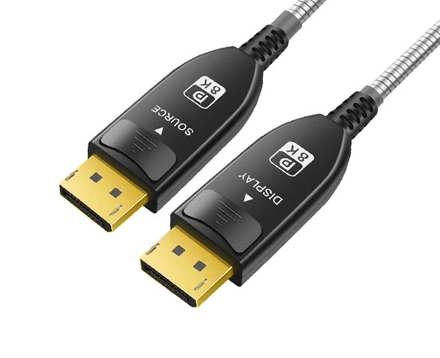
When gaming setups involve longer cable runs—such as PCs located away from displays—DisplayPort AOC cables ensure stable transmission at high bandwidth without signal loss or EMI interference.
In competitive and professional gaming environments, DisplayPort combined with AOC technology provides consistency that passive copper cables struggle to deliver.
For console gaming, HDMI is the practical and often required choice.
Native interface for PlayStation and Xbox
Strong support for 4K@120Hz gaming
HDMI VRR optimized for TV-based gaming
Universal compatibility with consumer displays
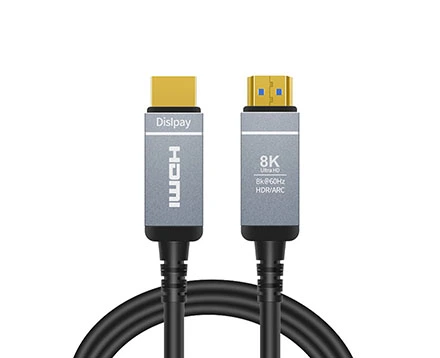
Modern consoles are typically used in living-room environments where cable lengths can exceed standard limits. An AOC HDMI cable allows gamers to place consoles in equipment racks or cabinets while maintaining full HDMI 2.1 performance to the TV or projector.
For large-screen gaming and home theater setups, HDMI AOC has become the preferred solution for reliable high-bandwidth transmission.
High-resolution, high-refresh gaming pushes signal integrity to its limits. This is where active optical cable technology directly impacts gaming performance.
Passive HDMI cables often fail beyond 2–3 meters at 4K@120Hz. HDMI AOC converts electrical signals to optical signals, enabling:
Long-distance runs (10–100 m)
Stable 4K/8K gaming output
Immunity to electromagnetic interference
Thinner, lighter cable installations
Similarly, DisplayPort AOC is widely used in:
Gaming arenas and esports venues
High-end PC gaming rooms
Multi-display gaming simulators
By removing copper limitations, DisplayPort AOC ensures consistent refresh rates and eliminates intermittent flicker or signal drops that can affect competitive play.
| Gaming Scenario | Recommended Interface | Cable Solution |
|---|---|---|
| Competitive PC gaming | DisplayPort | DisplayPort AOC |
| High-refresh gaming monitor | DisplayPort | DisplayPort AOC |
| Console gaming (PS5 / Xbox) | HDMI | HDMI AOC |
| Living-room gaming | HDMI | AOC HDMI cable |
| Long-distance PC-to-monitor | DisplayPort | DisplayPort AOC |
| Projector-based gaming | HDMI | HDMI AOC |
This practical view highlights a key industry reality: the right interface paired with the right cable matters more than interface marketing claims.
DisplayPort is generally better for 144Hz and higher refresh rates on PC monitors, especially when paired with DisplayPort AOC for longer distances.
HDMI 2.1 can match or exceed DisplayPort in some scenarios, particularly for 4K@120Hz console gaming. The difference becomes more pronounced in high-refresh PC gaming.
HDMI AOC cables do not change GPU performance, but they ensure stable signal delivery at high bandwidth, preventing flicker, dropouts, and resolution limitations over long distances.
For short runs, passive cables may work. DisplayPort AOC becomes essential when distance increases or when maximum refresh rates must be maintained reliably.
Both interfaces will continue to coexist. DisplayPort remains strong for PC gaming, while HDMI dominates consoles. In both cases, AOC technology is becoming the standard for high-performance gaming connections.
Choosing between HDMI and DisplayPort for gaming is not about which interface is "better" in isolation. It is about matching the interface, display, GPU, and cable technology to the gaming scenario.
For PC gamers chasing high refresh rates, DisplayPort paired with DisplayPort AOC delivers unmatched flexibility. For console and home theater gaming, HDMI combined with a high-quality AOC HDMI cable ensures reliable, future-ready performance.
As gaming resolutions and frame rates continue to rise, active optical cables are no longer optional—they are foundational to serious gaming setups.
Copyright © Shenzhen Fiberlink Tech Co., Ltd. All Rights Reserved. Trusted Partners:https://www.aocfiberlink.com/