English
A DVI fiber optic cable, also known as DVI AOC (Active Optical Cable), is a long-distance video transmission solution that converts electrical DVI signals into optical signals for transport over fiber. It is designed to overcome the distance, bandwidth, and signal-integrity limitations of traditional copper DVI cables, especially in professional and industrial environments.
DVI AOC is widely used where stable, high-resolution video must be delivered over tens or even hundreds of meters without compression, latency, or electromagnetic interference.
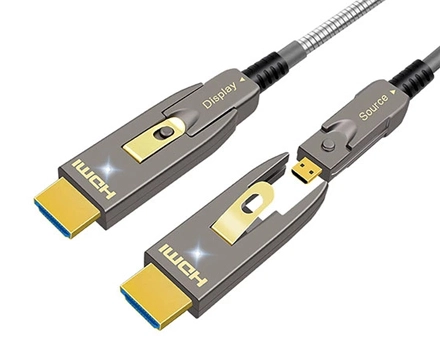
DVI AOC refers to a DVI Active Optical Cable that integrates optical fiber and active conversion circuitry inside the cable assembly.
Unlike passive DVI cables, which rely entirely on copper conductors, a DVI fiber optic cable contains:
Optical transceivers embedded in the connectors
Multimode or single-mode optical fibers
Minimal copper wiring for control and power
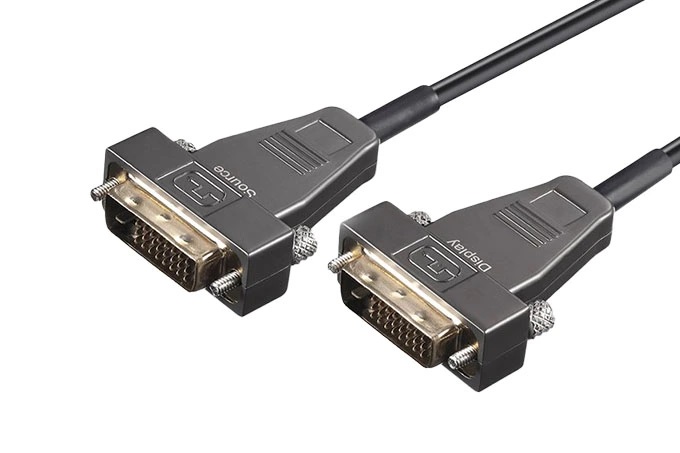
The DVI AOC actively converts TMDS electrical signals from the DVI source into optical signals, transmits them over fiber, and converts them back to electrical signals at the display end.
From a system perspective, DVI AOC behaves like a standard DVI cable—no external power, no drivers, and no configuration—while delivering dramatically improved transmission performance.
A DVI fiber optic cable operates through three key stages:
Electrical-to-Optical Conversion
At the source connector, the DVI TMDS signal is converted into an optical signal using an integrated optical engine.
Optical Signal Transmission
The signal travels through optical fiber, which is immune to electromagnetic interference and signal attenuation over long distances.
Optical-to-Electrical Conversion
At the display connector, the optical signal is converted back into a standard DVI electrical signal for the monitor or projector.
This active architecture allows DVI AOC cables to maintain signal integrity far beyond the limits of copper.
No. DVI AOC cables draw power directly from the DVI source port, making them plug-and-play for most professional equipment.
Passive DVI copper cables typically become unreliable beyond 5–10 meters at high resolutions.
A DVI fiber optic cable can support distances of 30 m, 50 m, or even 100 m+, depending on design.
Optical transmission eliminates:
Signal attenuation
Crosstalk
Ground loops
EMI/RFI interference
This makes DVI AOC especially suitable for electrically noisy environments such as factories, hospitals, and broadcast facilities.
DVI AOC cables are commonly used for:
DVI-D Single Link (1920×1200)
DVI-D Dual Link (2560×1600)
High-quality designs ensure stable pixel-perfect output with no compression or latency.
Compared to thick copper DVI cables, DVI AOC cables are:
Thinner
Lighter
Easier to route through conduits and racks
This reduces installation complexity in large projects.
From the device's perspective, a DVI AOC behaves like a standard DVI cable:
No drivers
No external power adapters
No signal converters required
| Feature | Passive DVI Copper Cable | DVI Extender (Cat/Fiber) | DVI AOC |
|---|---|---|---|
| Max Distance | 5–10 m | 50–300 m | 30–100 m |
| External Power | No | Yes | No |
| Latency | None | Possible | None |
| EMI Immunity | Low | Medium–High | High |
| Installation Complexity | Low | High | Low |
| Image Quality | Degrades with length | Depends on extender | Stable |
| System Cost | Low | High | Medium |
From a system design standpoint, DVI AOC offers the best balance between performance, simplicity, and reliability for long-distance DVI transmission.
Understanding the difference helps choose the right solution:
Mainly for video only
Widely used in legacy systems
No audio support (in most cases)
Supports video + audio
Consumer electronics standard
Limited long-distance stability without boosters
High bandwidth digital interface
Common in modern PC systems
Supports high refresh rates and resolutions
Fiber optic DVI is still used when legacy DVI systems require long-distance stable transmission.
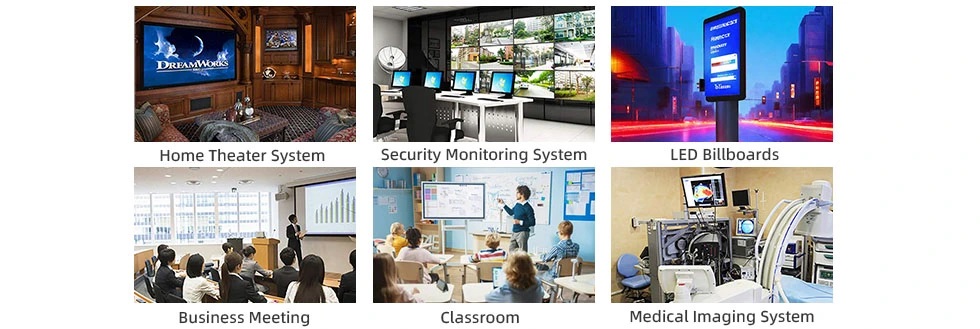
Factories and control rooms often require displays to be located far from signal sources. DVI AOC ensures stable operation in environments with heavy electrical noise.
Medical displays demand absolute signal integrity. DVI fiber optic cables are commonly used in:
Diagnostic imaging
Surgical display systems
Control rooms
Studios and live event venues use DVI AOC for:
Video walls
Production monitors
Equipment rack separation
Large-format displays and multi-screen systems benefit from long-distance, interference-free transmission without bulky extenders.
Secure facilities often require physically separated equipment rooms. DVI AOC supports long cable runs without signal degradation or electromagnetic leakage.
DVI is a mature interface, and newer standards such as HDMI and DisplayPort dominate consumer markets. However, DVI AOC continues to play a critical role in legacy and industrial systems.
Ongoing demand in installed-base systems
Many industrial and medical platforms are designed around DVI and will remain in service for years.
Replacement of copper with optical cables
As copper cable availability and performance decline, fiber-based DVI solutions become the preferred upgrade path.
Integration into hybrid AV systems
DVI AOC often coexists with HDMI AOC and DisplayPort AOC in complex installations.
For manufacturers and system integrators, DVI fiber optic cable remains a stable, high-margin niche product with long lifecycle demand.
Depending on design and resolution, DVI AOC cables typically support distances from 30 meters up to 100 meters or more.
Yes. Many DVI AOC designs support DVI-D Dual Link, enabling resolutions up to 2560×1600.
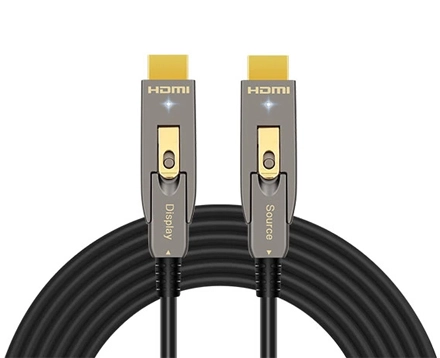
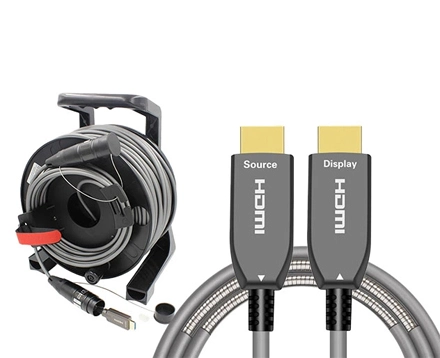
Yes. Most DVI AOC cables are directional and must be installed with the source and display ends correctly oriented.
In many cases, yes. DVI AOC provides long-distance transmission without external power, receivers, or transmitters, simplifying system design.
DVI AOC is compatible with standard DVI-D interfaces. Compatibility depends on device output power and resolution requirements.
A DVI fiber optic cable is not simply a longer DVI cable—it is a purpose-built optical transmission system designed for reliability, distance, and signal integrity. For industries that continue to rely on DVI, DVI AOC remains one of the most practical and robust solutions available.
As display infrastructures evolve, fiber-based connectivity is no longer optional. Even for legacy interfaces like DVI, optical technology ensures long-term performance and system stability in demanding professional environments.
Copyright © Shenzhen Fiberlink Tech Co., Ltd. All Rights Reserved. Trusted Partners:https://www.aocfiberlink.com/