English
With the rapid advancement of modern technology, high-definition displays and large-scale data transmission have become essential across many industries. Whether for home entertainment, gaming experiences, or enterprise-level professional applications, the quality of connections between display devices is critically important. To ensure stable, high-quality signal transmission, the DisplayPort AOC cable was developed. Not only does it support longer transmission distances, but it also guarantees signal integrity—even in complex environments—without any compromise in performance.
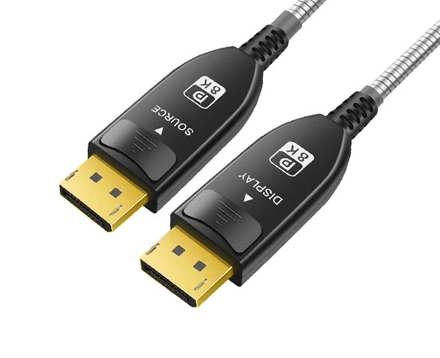
A DisplayPort active optical cable is a high-performance transmission cable that uses fiber optic technology, specifically designed for connecting devices that support the DisplayPort interface. It integrates fiber optic cores and built-in electronic chips to efficiently convert and transmit signals over long distances without degradation. Unlike traditional copper cables, the DisplayPort AOC transmits data using light signals, significantly improving signal stability and making it especially suitable for demanding visual applications.
The DisplayPort AOC cable is equipped with dedicated conversion chips that convert electrical signals into optical signals, which are then transmitted through the fiber. This process consists of two main stages:
At the transmitting end, electrical signals are converted into optical signals via the integrated chip. This chip ensures a stable and efficient conversion process. Once converted, the optical signal travels through the fiber at extremely high speed over long distances. Compared to electrical signals, optical signals are far less susceptible to electromagnetic interference, delivering much more stable transmission quality.
At the receiving end, another chip converts the incoming optical signal back into an electrical signal, which is then delivered to the display device or terminal. This conversion process allows the signal to be transmitted without loss, maintaining its integrity and ensuring accurate reproduction of high-definition video and audio.
Because the DisplayPort AOC uses optical signal transmission, it has distinct advantages over traditional electrical signal cables: it effectively avoids the common signal attenuation and loss associated with long-distance electrical transmission. This makes it particularly well-suited for environments requiring long-range, high-resolution data transfer.
As a result, DisplayPort active optical cables provide users with stable signal quality and can maintain high fidelity even in environments with strong electromagnetic interference—greatly enhancing the video and audio transmission experience.
Our latest FDPC-2101 Series 8K Fiber Optic DisplayPort 2.1 AOC cable (8K Fiber Optic DisplayPort 2.1 AOC-Active Optical Cable - AOCFiberLink) adopts the latest DP2.1 AOC+ technology and supports resolutions of 8K/60Hz, 4K/144Hz, 2K/240Hz, and 1080P, with a maximum bandwidth of 32.4Gbps. Transmission lengths can be customized up to 150 meters.
Copyright © Shenzhen Fiberlink Tech Co., Ltd. All Rights Reserved. Trusted Partners:https://www.aocfiberlink.com/