English
Broadcast TV infrastructure is undergoing a major transformation. As studios move from HD and conventional 4K workflows toward higher frame rates, HDR production, and 8K-ready systems, traditional video connectivity standards are reaching their limits. The challenge is no longer simply achieving higher resolution. Modern broadcast environments require guaranteed bandwidth, signal stability, long-distance transmission, and future-ready infrastructure.
This is why 8K HDMI 2.1 cables—and particularly HDMI 2.1 fiber optic cables—are becoming an increasingly important part of professional broadcast deployments. The transition is driven not by resolution marketing, but by operational stability, system simplification, and future-proofing requirements in live broadcast environments.
The adoption of HDMI 2.1 in broadcast studios is driven by several industry changes:
Broadcast studios are upgrading from HD and 4K to 8K workflows, requiring significantly higher bandwidth.
Modern sports and live production increasingly require:
60fps, 120fps workflows
Slow-motion replay systems
Real-time processing pipelines
Broadcast standards now commonly include:
HDR10
Dolby Vision workflows
10-bit and 12-bit color depth
These requirements exceed HDMI 2.0 capabilities.
Broadcast studios operate under conditions very different from home AV setups. Signals must travel longer distances, pass through complex routing systems, and remain stable under continuous operation.
Uncompressed 8K video transmission
48Gbps sustained bandwidth
Low latency for live production
Long cable runs between equipment rooms, control rooms, and studios
High immunity to electromagnetic interference
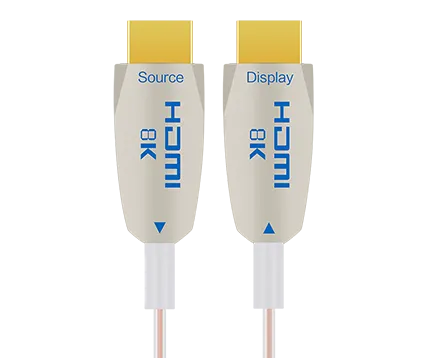
An 8K HDMI 2.1 cable 48Gbps meets these requirements at the interface level, while HDMI 2.1 fiber optic cable technology solves the physical transmission challenges that copper cables cannot.
Industry organizations such as the HDMI Forum and major broadcast system integrators increasingly specify HDMI 2.1 for next-generation studio builds, particularly where 8K-ready infrastructure is required even if current content remains 4K.
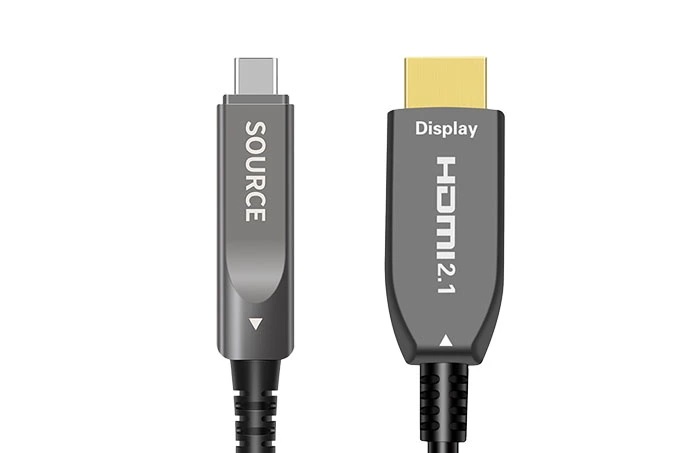
The introduction of HDMI 2.1 represents a major increase in video transmission capability.
HDMI 2.1 introduces a major bandwidth upgrade for professional video systems.
| Feature | HDMI 2.0 | HDMI 2.1 |
|---|---|---|
| Maximum bandwidth | 18Gbps | 48Gbps |
| Max resolution | 4K 60Hz | 8K 60Hz / 4K 120Hz |
| HDR support | Limited | Advanced |
| Frame rate | Standard | High-frame-rate ready |
| Broadcast suitability | Limited | High suitability |
The increase in bandwidth is the key reason HDMI 2.1 is adopted in modern broadcast environments.
In broadcast workflows, bandwidth headroom is critical. Even when output resolution is lower than 8K, higher bandwidth ensures:
Cleaner chroma sampling
Higher bit depth
Reduced compression artifacts
Compatibility with future camera and switcher upgrades
An HDMI 8K 2.1 cable rated at 48Gbps provides that margin, reducing the risk of mid-cycle infrastructure replacement.
Copper HDMI cables face physical limits that become problematic in broadcast facilities.
Signal degradation beyond 3–5 meters at 48Gbps
Sensitivity to EMI from lighting, power systems, and RF equipment
Thick, heavy cable bundles that complicate installation
Increased failure risk in permanent installations
An 8K HDMI 2.1 fiber optic cable converts electrical signals to optical signals at the connector level, enabling:
Long-distance transmission up to 100–150 meters
Complete immunity to electromagnetic interference
Stable 8K@60Hz performance without compression
Lightweight, flexible cable routing in racks and ceilings
Reduced need for extenders, repeaters, or converters
For broadcast studios, this translates directly into simpler system design and higher operational reliability.
| Parameter | Copper HDMI 2.1 Cable | HDMI 2.1 Fiber Optic Cable |
|---|---|---|
| Max Reliable Length @48Gbps | 2–3 m | Up to 150 m |
| EMI Resistance | Low | Excellent |
| Installation Weight | Heavy | Lightweight |
| Signal Stability | Distance-sensitive | Consistent |
| Broadcast Suitability | Limited | Ideal |
This is why most new broadcast studio projects specify fiber-based HDMI 2.1 cabling as standard practice.
In a professional TV studio, HDMI 2.1 cables are used as part of a larger signal chain.
Camera → Video Switcher → Signal Processor → HDMI 2.1 Transmission → Monitor Wall / Control Display
HDMI 2.1 is used at stages where:
High-resolution signal integrity is required
Real-time monitoring is needed
Multi-display synchronization is involved
SDI remains a foundational technology in professional broadcasting. However, HDMI 2.1 is increasingly used alongside SDI rather than replacing it.
| Feature | HDMI 2.1 | SDI |
|---|---|---|
| Usage | Monitoring / display | Core broadcast transmission |
| Distance | Short | Long distance |
| Industry adoption | Growing | Industry standard |
| Latency | Low | Very low |
HDMI 2.1 complements SDI systems rather than replacing them.
HDMI 2.1 supports native 8K@60Hz transmission at up to 48Gbps, making it suitable for uncompressed or lightly compressed broadcast workflows.
High-quality HDMI 2.1 fiber optic cables can reliably transmit 8K signals over distances up to 100–150 meters, depending on design and application.
Yes. HDMI 2.1 is increasingly used in broadcast studios for monitoring, production displays, and internal signal distribution where high resolution and reliability are required.
HDMI 2.1 does not replace SDI for all use cases, but it is widely adopted for display-centric workflows and internal connections where ultra-high resolution is required.
The growing adoption of HDMI 2.1 in broadcast TV studios is driven by practical engineering requirements rather than marketing trends. Higher bandwidth, support for 8K workflows, HDR production, high-frame-rate content, and long-term infrastructure planning are encouraging broadcasters to deploy HDMI 2.1-based systems throughout their facilities.
For installations requiring long-distance transmission, stable 48Gbps performance, and immunity to electromagnetic interference, HDMI 2.1 fiber optic cables provide clear advantages over traditional copper solutions. As broadcast infrastructure continues to evolve, fiber-based HDMI 2.1 connectivity is becoming an increasingly important component of modern studio design.
Copyright © Shenzhen Fiberlink Tech Co., Ltd. All Rights Reserved. Trusted Partners:https://www.aocfiberlink.com/