English
In the digital age, copyright infringement has become increasingly common, causing significant losses across the industry. To combat this, HDCP (High-bandwidth Digital Content Protection) was developed to protect digital content. While often unnoticed, HDCP plays a key role in everyday experiences such as watching TV shows and movies.
HDCP (High-bandwidth Digital Content Protection) is an encryption technology developed by Intel to prevent unauthorized copying of digital audio and video content. It protects data transmitted over interfaces such as HDMI, DisplayPort (DP), DVI, GVIF, and UDI.
HDCP works by securing the signal path between source devices (such as Blu-ray players or set-top boxes) and display devices like monitors or smart TVs. However, HDCP only functions when all connected components—including transmitters, receivers, splitters, and cables—are HDCP-compliant and properly licensed. Non-compliant devices can result in playback issues, especially with HDCP-protected content from platforms like Netflix or Disney.
It’s also important to note that HDCP applies only to wired connections. When content is streamed directly through built-in apps, HDCP is not involved.
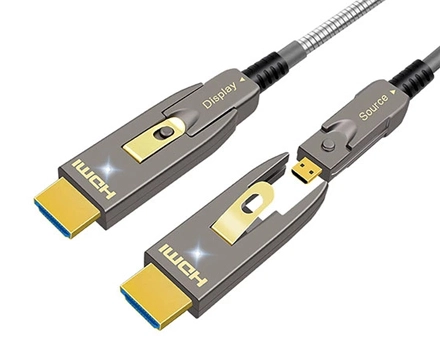
NOTE: HDCP is often confused with HDMI, but they serve different purposes. HDCP is a software-based content protection protocol, while HDMI is a hardware interface used to transmit digital audio and video. Most HDMI cables support HDCP when connecting HDCP-compliant devices.
HDCP works by creating a secure connection between source and display devices through an authentication “handshake.” The source device encrypts the digital content before transmission. Each HDCP-compliant device contains a unique private key and a Key Selection Vector (KSV). During authentication, the source and receiver exchange KSVs to verify that the receiving device is authorized. Once verified, a secure, encrypted link is established, allowing the content to be decrypted and displayed.
HDCP operates through three key processes:
Authentication: Verifies that both the source and the display device are authorized HDCP devices and allows them to exchange encryption keys.
Revocation: Detects compromised devices and blocks them from transmitting or receiving protected content.
Encryption: Encrypts the signal during transmission over cables to prevent unauthorized copying.
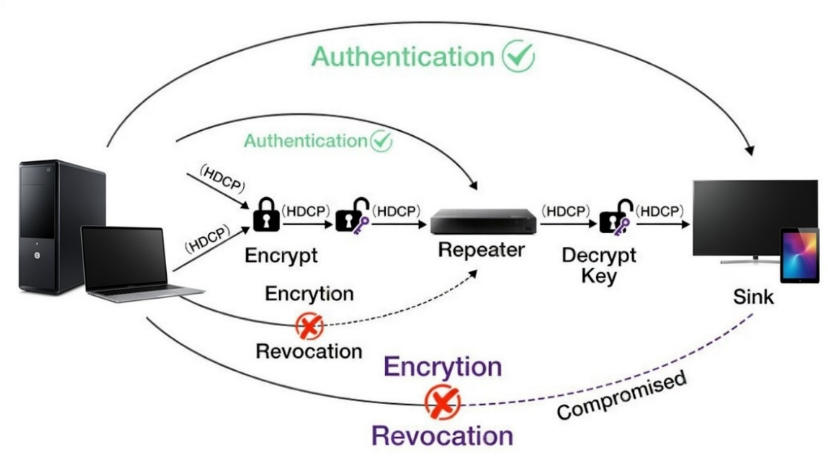
Over the years, HDCP has evolved from version 1.0 to 2.3. Early versions such as HDCP 1.0 supported only DVI connections, while later versions expanded support to interfaces including HDMI, DisplayPort (DP), GVIF, and UDI.
Today, HDCP 1.4 and HDCP 2.2 are the most commonly used versions. HDCP 1.4 was designed for Full HD content, whereas HDCP 2.2 supports 4K media. To watch 4K content smoothly, all devices in the signal chain must support HDCP 2.2.
The latest version, HDCP 2.3, introduces updated encryption and decryption algorithms and adds support for 8K resolution while remaining backward compatible. However, compatibility issues may occur if some devices are not updated to support newer HDCP standards.
HDCP is a crucial technology in protecting digital content from unauthorized access and piracy. It plays an important role in protecting the rights of content owners. As digital content consumption continues to evolve, HDCP remains a fundamental component in preserving the integrity and security of copyrighted content.