English
We've all been there. You urgently need to transfer videos from your phone to your computer, only to find that plugging it in via cable is slower than using Wi-Fi. Or you buy a new monitor that supports "single-cable connectivity", grab what looks like a compatible charging cable, and—no signal.
The Type-C port was once hailed as the universal solution, promising to unify all connections. So how did we end up in such a mess? How many types of USB cables are actually out there? And how do you pick the right one? Whether it's for screen mirroring, charging, or transferring files—what should you look for when buying a cable? Let's break it down.
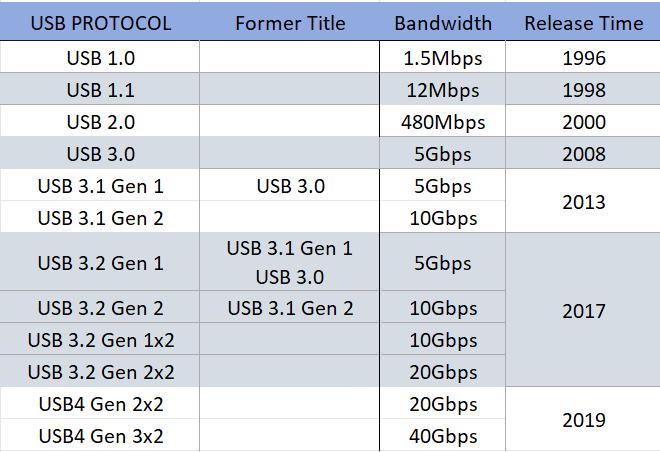
The following picture shows the development of the USB protocol. It can be seen that the naming of USB is very confusing.
The physical interfaces of USB in different versions are also different, as shown in the following figure.

The original vision for Type-C was simple and ambitious: one port to rule them all. Data, audio-video, and power—all handled by a single cable.
But this very versatility has led to its biggest problem: identical appearance, completely different capabilities.
Take HDMI, for example. If the plug fits, you'll most likely get a display signal. But with Type-C, even if it plugs in perfectly, it might only charge, only transfer data, or do both—or neither. It all comes down to what protocols the cable and devices support.
For instance, some smartphones with Type-C support fast charging, high-speed data transfer, and video output. Others? Maybe only proprietary charging and USB 2.0-speed data.
Not all USB Type-C ports are all-rounders. To transmit video, the Type-C port needs to support the DisplayPort protocol. USB Type-C is merely a physical interface form. Although it supports PD charging, USB data transfer, and DisplayPort display, in reality, it depends on whether the device manufacturer has equipped it with the corresponding functions.
Although the current Type-C world seems like a complete mess,But from a technical perspective, it remains the most promising generation of interfaces.Unified form, stronger bandwidth, higher power upper limit.Make it fully compatible on laptops, tablets, mobile phones and even monitors.As long as the industry gradually standardizes its identification and users have a little more understanding,The dream of "plugging it in anywhere" will come true sooner or later.
Copyright © Shenzhen Fiberlink Tech Co., Ltd. All Rights Reserved. Trusted Partners:https://www.aocfiberlink.com/