English

If there's one metric that defines HDMI 2.2, it's raw speed. With a staggering 96 Gbps bandwidth, the new standard almost sounds over-engineered. For most movie lovers or TV users, HDMI 2.1b already offers more than enough capacity — unless you're pushing into 8K workflows.
So why the jump? The answer lies in gaming. Competing interfaces like DisplayPort 2.1a already deliver up to 80 Gbps, and the latest GPUs are outputting 4K at 480 Hz. HDMI 2.2 isn't trying to catch up — it's preparing for the future. By expanding its data ceiling, it ensures the connection can keep pace with the next generation of displays, consoles, and media hardware arriving later this decade.
We've barely gotten comfortable with 4K, yet display innovation keeps accelerating. HDMI 2.2 opens the door to uncompressed 8K RGB video, letting massive OLED and Mini LED panels reveal colour depth and clarity at an almost lifelike level.
For consumers, it's about realism so convincing that screens begin to look like windows into another world. And while 8K might sound ambitious, HDMI 2.2 is already designed to scale up to 16K resolutions, setting the stage for future broadcast, medical, and industrial applications that demand extreme visual precision.
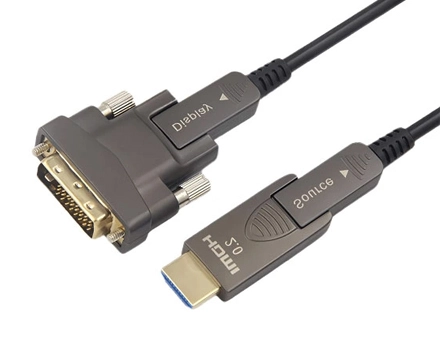
To unlock the full potential of HDMI 2.2, the cable itself must evolve. That's where the Ultra96 HDMI Cable comes in — a new certification designed to handle the full 96 Gbps load with absolute stability.
Despite the leap in capacity, these cables remain fully backward-compatible, meaning your existing setup doesn't need a complete overhaul. Compared to the first-generation HDMI cables from 2002, the Ultra96 boasts nearly 20 times the data throughput, making it a smart long-term investment for both professional and home use.
As upcoming TVs, projectors, and gaming systems adopt HDMI 2.2, having Ultra96 cables in place ensures you're ready for the next performance leap.
Anyone who's wrestled with HDMI's CEC sync issues knows the frustration of lagging audio or off-beat dialogue. HDMI 2.2 introduces HDMI 2.2 LIP (Latency Indication Protocol) — a game-changing addition that lets devices communicate latency in real time and automatically align playback.
Even complex multi-hop setups benefit, where multiple devices are daisy-chained through AV receivers or soundbars. The result? Perfect sync, regardless of how your system is wired. For the first time, HDMI can promise what audiophiles and cinephiles have wanted for years — truly seamless coordination between sight and sound.
Gaming remains HDMI's most demanding arena, and HDMI 2.2 meets that challenge head-on. Expect uncompressed 4K at 240 Hz with 12-bit colour, delivering a smoothness and visual depth that make virtual worlds feel real.
But this isn't just about games. HDMI 2.2 underpins the next generation of AR, VR, MR, Spatial Reality, and Light Field Displays, providing the bandwidth and consistency these technologies require.
Underneath it all lies Next-Gen Fixed Rate Link (FLR) — a smarter, more efficient transport layer that ensures HDMI 2.2 will adapt to future standards we haven't even imagined yet. Combined with LIP, it's clear this isn't a minor revision. It's a foundation for the next decade of visual innovation.
HDMI 2.2 isn't here to replace HDMI 2.1 HDMI cable overnight, but it signals a bold shift toward a higher-performance, future-ready ecosystem. For most consumers, today's devices may not demand 96 Gbps — but the coming wave of ultra-high-refresh, high-bit-depth displays will.
Think of HDMI 2.2 as a bridge to that future: invisible, reliable, and ready for whatever your screen dreams up next.
Copyright © Shenzhen Fiberlink Tech Co., Ltd. All Rights Reserved. Trusted Partners:https://www.aocfiberlink.com/