English
An 8K HDMI fiber optic cable can reliably transmit signals 30 to 100 meters or more without quality loss, depending on the cable design and installation environment. Unlike copper HDMI cables, which typically max out at 3–5 meters for stable 8K transmission, fiber optic HDMI cables use light instead of electrical signals. This allows them to deliver the full 48 Gbps bandwidth required for HDMI 2.1 features (8K@60Hz, 4K@120Hz, HDR, eARC, VRR) across long distances with no noticeable degradation.
If you need to extend HDMI beyond 5 meters at 8K resolution, fiber optic is the only reliable choice.
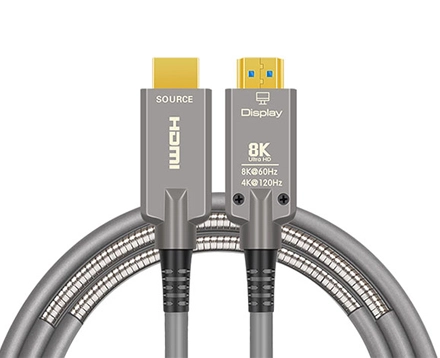
Before we get into fiber optic advantages, it's worth understanding the limits of copper HDMI:
Signal attenuation: Electrical resistance increases over distance, weakening the signal.
Bandwidth bottlenecks: Copper struggles to maintain 48 Gbps over anything longer than 5–7 meters.
EMI/RFI interference: In environments with heavy electronics, copper HDMI easily picks up noise.
Bulk and stiffness: Long copper HDMI cables become thick, heavy, and hard to install.
This is why, in real-world applications, installers almost always choose fiber optic HDMI once runs exceed 7 meters.
The secret to long-distance performance lies in how 8k hdmi fiber optic cables work:
Electrical-to-Optical Conversion:
At the source (Blu-ray player, PS5, GPU), the HDMI signal is converted into optical signals via a built-in chipset.
Transmission Through Fiber Strands:
Light pulses travel through ultra-thin glass or plastic fibers. Unlike copper, light is not affected by resistance or interference.
Optical-to-Electrical Conversion:
At the display (8K TV, projector, monitor), another chipset converts the optical signal back into HDMI electrical signals.
Stable Output:
The display receives a lossless HDMI 2.1 signal, even over 100 meters.
This makes fiber HDMI the only solution for large-scale AV, home theaters, conference halls, stadiums, and medical imaging systems.
While the exact distance varies by manufacturer and design, here are general benchmarks:
Standard Copper HDMI: Reliable up to 3–5 meters for 8K; 7 meters max with premium quality.
Active Copper HDMI: Sometimes up to 10–15 meters using built-in signal boosters, but not guaranteed at full 48 Gbps.
8K HDMI Fiber Optic Cable (Copper + Fiber Hybrid): Typically 30–50 meters without signal loss.
Full Fiber HDMI (High-End): 50–100 meters or more, fully stable at 48 Gbps, 8K@60Hz, 4K@120Hz.
Industry experience shows that most commercial AV projects use 30–50m fiber HDMI runs, while stadium and digital signage installs often require 100m+.
Do fiber optic HDMI cables lose signal over distance?
No, not in practical terms. Light signals travel with negligible attenuation compared to copper. Most 8K HDMI fiber cables can run 100m+ without visible degradation.
How long can HDMI 2.1 cables run without loss?
Copper HDMI 2.1 cables: ~3–5 meters.
Fiber optic HDMI 2.1 cables: 30–100 meters depending on quality.
Do HDMI fiber cables support 4K as well as 8K?
Yes. They are fully backward compatible with HDMI 2.0/1.4, meaning they support 4K, 1080p, and even older resolutions while future-proofing for 8K.
Are HDMI fiber optic cables directional?
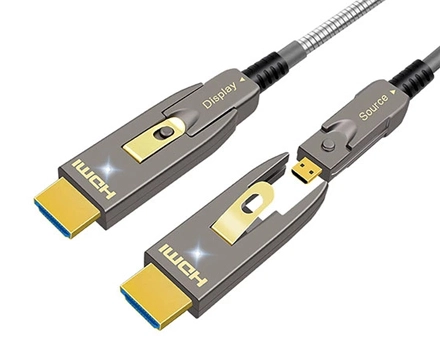
Yes. They are labeled with Source → Display ends. Reversing them won't work.
Do fiber HDMI cables require external power?
No. The chipsets draw low voltage directly from HDMI ports—no adapters are needed.
Even though fiber HDMI supports long runs, performance depends on several technical and environmental factors:
Glass fiber generally offers better long-distance stability than plastic fiber.
Hybrid cables (fiber for data + copper for control signals) balance flexibility and performance.
4K@60Hz requires ~18 Gbps.
8K@60Hz HDR requires the full 48 Gbps.
The higher the bandwidth demand, the more critical fiber HDMI becomes.
EMI-heavy environments (factories, hospitals, server rooms) require fiber HDMI for reliable operation.
Bends or sharp angles can damage fibers—always follow minimum bend radius guidelines.
High-quality chipsets, shielding, and connectors ensure full performance.
Low-cost uncertified cables may work at first but fail under load.
Running HDMI across walls or ceilings to a projector 10–20 meters away requires fiber HDMI to maintain Dolby Vision and Atmos without signal drops.
Control racks may be located far from displays. Fiber HDMI ensures stable 8K visuals across 30–50m runs.
Shopping malls, airports, and stadium displays demand long HDMI runs—often 50–100m—where copper is impossible.
Studios and arenas need zero-latency UHD distribution over extended distances. Fiber HDMI ensures reliability.
8K resolution is used in surgical imaging systems. Fiber HDMI ensures clear, interference-free transmission in EMI-heavy hospital environments.
Some buyers ask if active copper HDMI can replace fiber HDMI. While active copper cables include built-in amplifiers, they:
Rarely exceed 10–15m at 8K.
Still suffer from EMI.
Add bulk and require careful power management.
By contrast, fiber HDMI reliably reaches 50–100m with no interference.
Always connect Source → Display as marked.
Avoid tight bends; maintain manufacturer's minimum bend radius.
Keep fiber HDMI separate from copper power lines to simplify routing and minimize stress.
Verify signal stability (8K@60Hz or 4K@120Hz) before sealing walls or conduits.
So, how far can an 8K HDMI fiber optic cable transmit signal without loss?
At least 30–50 meters reliably, with premium models reaching 100 meters or more.
Compared to copper HDMI's 3–5 meter limitation, fiber HDMI is the only practical solution for long-distance 8K and professional AV setups.
If your project involves:
Projectors, large displays, or stadium signage
High-interference environments like hospitals or factories
Future-proofing for HDMI 2.1 and beyond
…then an 8K HDMI fiber optic cable isn't just an option—it's a necessity.
Copyright © Shenzhen Fiberlink Tech Co., Ltd. All Rights Reserved. Trusted Partners:https://www.aocfiberlink.com/