English
An 8k HDMI fiber optic cable is the only reliable way to deliver uncompressed, high-bandwidth HDMI 2.1 signals across long distances in home theaters, professional studios, and large venues. While copper HDMI cables are sufficient for short runs, they quickly fail to support 8K@60Hz or 4K@120Hz beyond 3–5 meters. Fiber optic HDMI cables solve this problem by transmitting data as light signals, enabling 30–100+ meters of lossless, interference-free performance.
If you're planning a projector-based home theater, a broadcast studio, or a stadium-scale AV setup, 8K HDMI over fiber isn't just an upgrade—it's essential.
Traditional copper HDMI cables face three critical limitations at high bandwidths:
Distance limits: Stable 8K transmission over copper maxes out at ~3–5m.
Signal loss & attenuation: Copper suffers degradation as distance increases.
Electromagnetic interference (EMI): Nearby electronics and power cables disrupt copper signals.
By contrast, fiber HDMI cables:
Carry light signals immune to EMI.
Deliver the full 48 Gbps bandwidth required for HDMI 2.1.
Maintain signal integrity over tens or even hundreds of meters.
This makes 8K HDMI fiber optic cable the professional standard for demanding AV environments.
The technology is straightforward but powerful:
Electrical-to-optical conversion:
At the source (Blu-ray, GPU, PS5, AV receiver), the HDMI signal is converted to optical signals using built-in chipsets.
Optical transmission:
Light travels through fiber strands with virtually no loss.
Optical-to-electrical conversion:
At the display end (8K TV, projector, monitor), the signal is converted back into HDMI electrical form.
Lossless output:
The display receives a clean, uncompressed signal at full HDMI 2.1 bandwidth.
Unlike copper extenders or repeaters, this process happens in real time with negligible latency, making fiber HDMI suitable for gaming, broadcasting, and medical imaging.
Modern home theaters often involve:
Projectors mounted 10–20 meters away.
AV receivers located in separate equipment rooms.
Dolby Vision and Dolby Atmos requirements.
A copper HDMI cable would struggle at these lengths, especially at 4K@120Hz or 8K@60Hz. An 8K HDMI fiber optic cable ensures stable, future-proof performance.
Key Benefits in Home Theaters:
Reliable HDR delivery (HDR10+, Dolby Vision).
Full support for eARC audio to deliver lossless surround sound.
Slim, flexible cables for easier installation behind walls.
In broadcasting and production environments:
Cameras, switchers, and monitors may be spread across large control rooms.
Consistency is critical—a single signal dropout is unacceptable.
Fiber HDMI ensures:
Zero-latency 8K and 4K high-refresh signals.
Freedom from interference caused by powerful broadcast equipment.
Long-distance reliability, reducing the need for signal extenders or repeaters.
Practical Example: Many eSports studios have switched to fiber HDMI to handle multi-camera 4K/8K feeds without risking sync errors or frame loss.
For stadiums, concert halls, and auditoriums, HDMI runs often exceed 30–50 meters. Copper cables simply cannot handle this. Fiber HDMI cables are ideal for:
Scoreboard video feeds.
Stage-to-screen projection in concerts.
Control-room-to-display routing in auditoriums.
Why Fiber Wins in Large Venues:
Immune to interference from lighting rigs, sound systems, and industrial electronics.
Lightweight cables simplify installation across long distances.
8K resolution ensures a premium experience for large audiences.
How far can 8K HDMI run over fiber?
Up to 100 meters or more depending on the quality of the cable. By comparison, copper HDMI maxes out at ~3–5 meters for 8K.
Is fiber HDMI better than copper HDMI?
Yes. Fiber HDMI is immune to EMI, supports longer distances, and maintains full HDMI 2.1 bandwidth. Copper works only for short, budget-friendly runs.
Do fiber HDMI cables need external power?
No. The conversion chipsets draw low power directly from HDMI ports.
Are fiber HDMI cables fragile?
They must be handled carefully during installation—avoid sharp bends and crushing. Following manufacturer bend radius guidelines prevents damage.
Do fiber HDMI cables add latency?
No. Signal conversion occurs in real time, making them suitable even for competitive gaming and broadcasting.
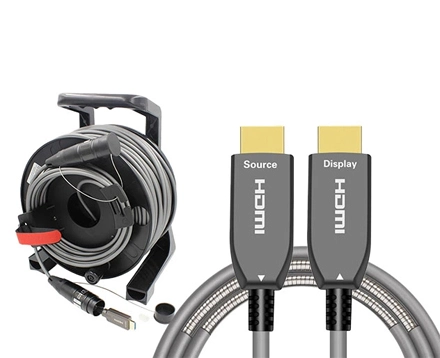
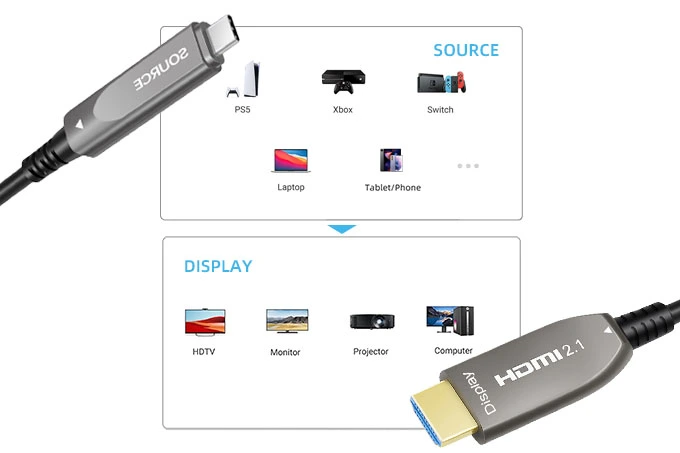
Fiber HDMI cables are directional—one end is labeled Source, the other Display. Reversing them won't work.
Exceeding bend radius can damage fibers. Typically, installers should allow 20–30mm radius curves.
Look for Ultra High Speed HDMI Certification to guarantee full 48 Gbps compliance.
Ensure all devices in the chain (source, AVR, display) support HDMI 2.1. A single HDMI 2.0 device can bottleneck the system.
Reinforced jackets and Kevlar protection for durability.
Gold-plated connectors for stable contact.
Hybrid copper + fiber designs (for power and control channels).
| Environment | Copper HDMI | Fiber HDMI |
Home Theaters | Works for ≤3m; unreliable for projectors | Best for 10–20m+ projector setups |
Studios | Susceptible to EMI, limited distance | Reliable, interference-free 8K feeds |
Large Venues | Not practical beyond 5m | Standard for 30–100m runs |
Gaming | Only feasible at short desk setups | Perfect for high-refresh, long runs |
Medical Imaging | Risks interference, low reliability | Clear, stable UHD signals in EMI-heavy environments |
Pre-test cables at full resolution before permanent installation.
Label ends clearly to avoid directionality errors.
Avoid mixing with power lines to protect hybrid designs.
Use conduit with smooth curves to prevent fiber stress.
Educate clients on the advantages of fiber vs copper for long-term planning.
For modern home theaters, professional studios, and large venues, copper HDMI cables have reached their limits. Only an 8K HDMI fiber optic cable can deliver:
30–100m+ transmission without loss
48 Gbps HDMI 2.1 performance (8K@60Hz, 4K@120Hz, HDR, eARC, VRR)
Interference immunity in
Copyright © Shenzhen Fiberlink Tech Co., Ltd. All Rights Reserved. Trusted Partners:https://www.aocfiberlink.com/