English
From an industry and technical standpoint, an 8K HDMI cable is generally a better choice for new projects because it supports the latest HDMI 2.1 specification with up to 48 Gbps bandwidth, backward compatible with HDMI 2.0 and HDMI 1.4, enabling both 4K and 8K video formats, higher refresh rates, and advanced audio features. While a 4K HDMI cable (typically HDMI 2.0) is sufficient for most of the existing applications, it is more limited in bandwidth, refresh rate capability, and long-term compatibility.
For buyers in AV integration, broadcast, and large-scale installations, this choice affects system scalability, signal stability, and investment longevity.
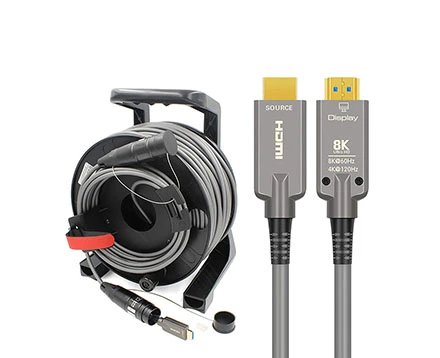
4K HDMI Cable (High-Speed, HDMI 2.0 standard):
Maximum bandwidth: 18 Gbps
Supports 4K@60Hz (4:4:4 chroma), HDR10, and most professional video requirements today.
Not designed for 8K or high-frame-rate 4K beyond 60Hz.
8K HDMI Cable (Ultra High-Speed, HDMI 2.1 standard):
Maximum bandwidth: 48 Gbps
Supports 8K@60Hz, 4K@120Hz, and even 10K resolutions with DSC.
Ideal for future-proofing large investments and enabling high-refresh-rate workflows.
Industry note: An 8K cable will always handle 4K content, but the reverse is not true.
4K Cable User Cases:
Conference room AV systems with 4K displays.
Standard digital signage applications.
Broadcast systems still in 4K workflow stages.
8K Cable User Cases:
Large-format LED video walls with pixel density upgrades planned.
Live event production where high refresh rates (4K@120Hz) improve motion clarity.
Medical imaging systems requiring ultra-high resolution for diagnostic accuracy.
High-end simulation and VR display integration.
Bandwidth requirements are directly related to transmission challenges:
Copper HDMI cables carrying 48 Gbps are typically limited to 2–3 meters for stable performance.
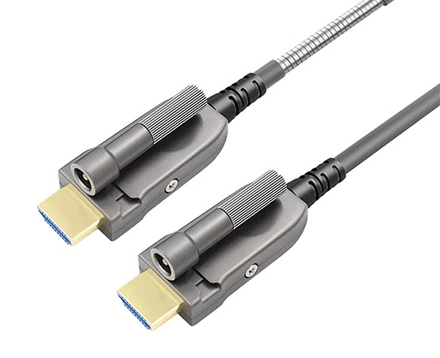
For longer runs, especially in professional environments, 8K-rated Active Optical Cables (AOCs) are essential to maintain full spec performance up to 150 meters without repeaters.
4K copper cables can reach 5–10 meters more easily but cannot match 8K's feature set.
4K HDMI cables may be adequate for current needs but could require replacement when upgrading to 8K displays or higher refresh rate 4K systems.
8K HDMI cables ensure compatibility with all HDMI 2.1 devices while fully supporting legacy 4K and 1080p systems, making them the safer long-term investment in B2B projects.
4K cables: Lower cost, but risk of early obsolescence in high-end projects.
8K cables: Higher upfront cost, but eliminate the need for future rewiring when system upgrades occur.
In large installations (stadiums, control rooms), the cost of cable replacement far exceeds the price difference between 4K and 8K cables, making 8K the more economical choice over time.
When implemented as fiber optic HDMI AOC:
Both 4K and 8K cables have excellent EMI immunity.
The difference lies in the optical transceiver capability inside the cable head — 8K AOCs are built with higher-speed components, ensuring lower bit error rates and better stability at maximum bandwidth.
| Feature | 4K HDMI Cable (HDMI 2.0) | 8K HDMI Cable (HDMI 2.1) |
Max Bandwidth | 18 Gbps | 48 Gbps |
Max Resolution | 4K@60Hz | 8K@60Hz, 4K@120Hz, 10K with DSC |
HDR Support | HDR10, Dolby Vision | HDR10+, Dolby Vision, Dynamic HDR |
Max Copper Length | ~5–10m | ~2–3m |
AOC Length Capability | 300m+ | 150m+ |
Ideal Use Case | Current 4K systems | Future-proof, high-refresh, 8K-ready |
In short-term, fixed 4K environments, a 4K HDMI cable is adequate and cost-effective. However, for professional AV, broadcast, medical, and simulation projects — where high refresh rates, long cable runs, and future scalability are important — an 8K HDMI cable, ideally in fiber optic AOC form, is the superior choice.
Choosing 8K now ensures your infrastructure can handle both today's and tomorrow's highest performance requirements without costly retrofits.
Copyright © Shenzhen Fiberlink Tech Co., Ltd. All Rights Reserved. Trusted Partners:https://www.aocfiberlink.com/