English
Compared to HDMI 2.1, HDMI 2.2 introduces the Latency Indication Protocol (LIP), designed to improve the synchronization of audio and video signals. This clearly demonstrates HDMI 2.2's commitment to further enhancing audio-video synchronization across the entire signal transmission chain.
In fact, LIP is not the only technology HDMI employs to address audio-video latency. Features such as ARC (introduced with HDMI 1.4 in 2009) and eARC (introduced with HDMI 2.1 in 2017) already incorporate "Lip Sync Correction" technology to manage audio-video synchronization.
Compared to traditional digital coaxial or optical audio transmission methods, HDMI ARC and eARC offer significant advantages. The table below summarizes the key technical benefits: the ability to transmit higher-specification surround sound signals—supporting up to 192kHz, 24-bit, 32-channel uncompressed audio—as well as Dolby Atmos and DTS:X, and, crucially, Lip Sync Correction technology. Another advantage of ARC and eARC is that they allow audio signals to be transmitted via the TV to a home theater amplifier or soundbar, even when the playback device does not support dual HDMI outputs.
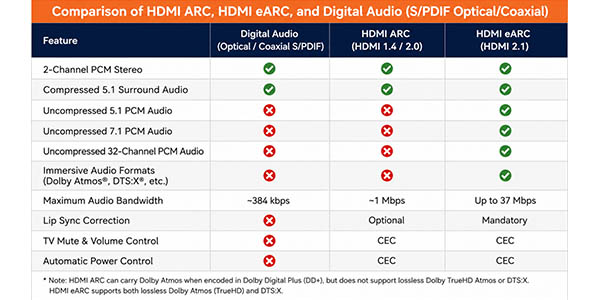
What's the difference between ARC and eARC? Know more at: ARC and eARC difference.
The LIP (Latency Indication Protocol) is designed to address audio-video synchronization latency across the entire HDMI transmission chain. It is particularly suited for systems involving multiple connected devices—such as multi-hop configurations incorporating various signal sources, home theater amplifiers, and soundbars—by providing precise latency control. Its primary use cases are in video gaming and home theater environments.
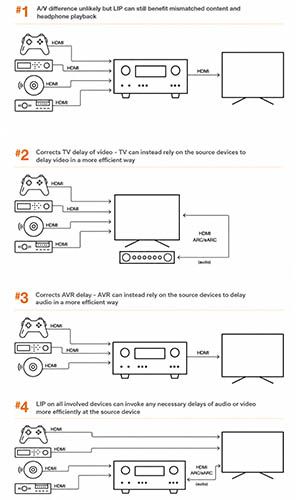
In fact, as is evident from the various application scenarios of LIP technology discussed earlier, the LIP technology employed in HDMI 2.2 addresses the entire audio-video transmission loop, whereas the Lip Sync Correction technology found in ARC/eARC focuses solely on the audio return channel. It can be said that the HDMI 2.2 LIP technology offers a broader scope for latency optimization and involves a higher level of processing.
The main difference between HDMI 2.1 and HDMI 2.2 is bandwidth. HDMI 2.1 supports up to 48Gbps, while HDMI 2.2 increases the maximum bandwidth to 96Gbps. This allows HDMI 2.2 to support higher resolutions, refresh rates and uncompressed video formats, including advanced 8K and 4K high-refresh-rate applications. However, the source device, display and cable must all support the required features.
HDMI 2.2 is technically more capable than HDMI 2.1, but it is not necessary for every system. HDMI 2.1 remains suitable for most 4K gaming, 4K@120Hz and 8K@60Hz setups. HDMI 2.2 is more relevant for next-generation displays, professional AV systems and applications requiring bandwidth above 48Gbps. Buyers should compare the actual supported resolution, refresh rate and bandwidth rather than relying only on the HDMI version number.
The maximum HDMI 2.2 speed is 96Gbps, which is twice the maximum bandwidth of HDMI 2.1. This additional capacity supports higher resolutions, faster refresh rates and uncompressed full-chroma video formats. To access the full 96Gbps capability, the system requires compatible HDMI 2.2 devices and a certified Ultra96 HDMI Cable. An Ultra High Speed HDMI Cable is designed for systems operating at up to 48Gbps.
In an HDMI ARC vs eARC comparison, both technologies return TV audio to a soundbar or AV receiver through the same HDMI connection. eARC provides significantly greater audio capacity and supports high-bitrate formats such as Dolby TrueHD, Dolby Atmos, DTS-HD Master Audio and DTS. It can also carry uncompressed 5.1 and 7.1 audio. Both connected devices must support eARC to receive its full audio benefits.
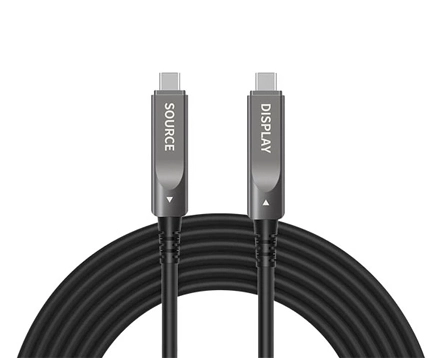
An HDMI 2.1 AOC is an active optical cable that typically uses optical fibers for high-speed signal lanes and copper conductors for auxiliary functions. This construction enables longer and thinner cable runs than many passive copper cables. A 48Gbps HDMI 2.1 AOC may work with HDMI 2.2 devices within its rated capability, but it cannot automatically deliver the full 96Gbps bandwidth of HDMI 2.2. Check the cable’s certified bandwidth before purchasing.
No. HDMI HDCP 2.2 and HDMI 2.2 are different technologies. HDMI 2.2 defines audio-video transmission capabilities, including bandwidth and supported formats. HDCP 2.2 is a content-protection protocol used to authenticate compatible devices before protected video is transmitted. A source, receiver, splitter or display that lacks the required HDCP support may be unable to display protected content, even when its HDMI connection supports the required resolution.
Copyright © Shenzhen Fiberlink Tech Co., Ltd. All Rights Reserved. Trusted Partners:https://www.aocfiberlink.com/