English
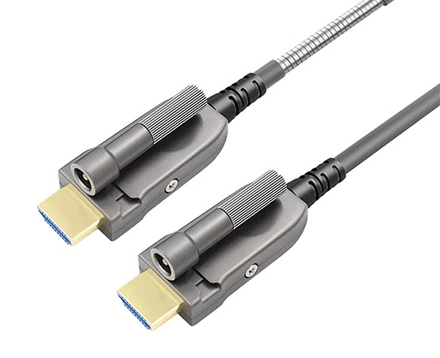
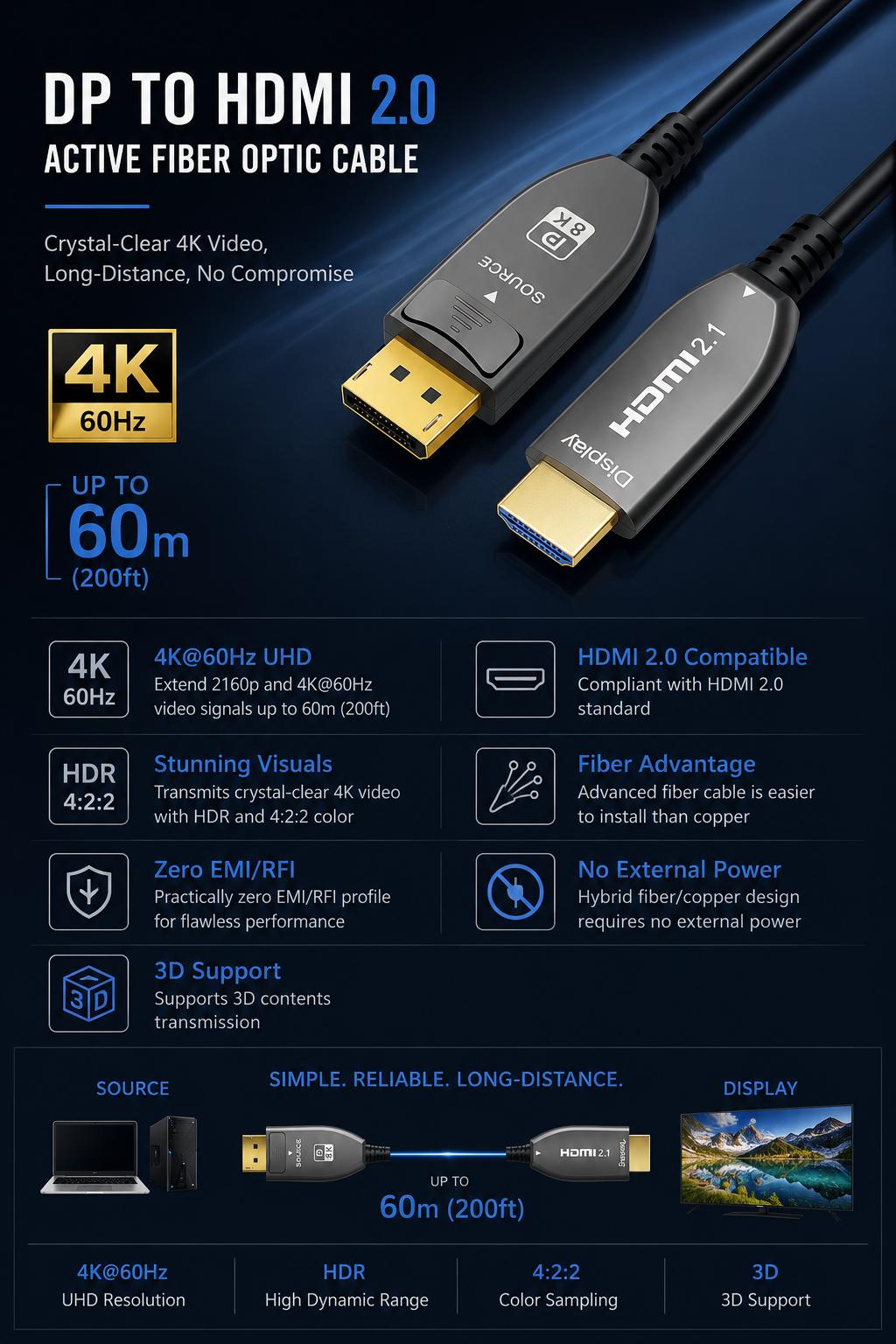
The core technology of DP to HDMI fiber optic cables is not merely a physical interface conversion, but an active, unidirectional transmission system integrating protocol conversion and electro-optical conversion.
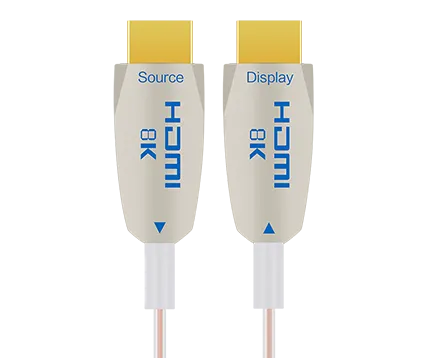
First, at the signal source end, DP to HDMI signal conversion is performed, converting the DP signal to an HDMI signal. Then, the HDMI electrical signal is converted back to an optical signal for long-distance transmission. At the display end, the signal undergoes another electro-optical conversion. It converts optical signals into HDMI electrical signals. This process does not require additional adapters/amplifiers; a single fiber optic DP to HDMI cable is sufficient.
Active DP to HDMI cables can stably support long-distance transmission of 4K@60Hz. DP to HDMI fiber optic cables can reach distances up to 60 meters, and their fiber optic characteristics make them resistant to electromagnetic interference, providing extremely high stability. They are suitable for connecting desktop graphics cards and laptops to TVs, projectors, video walls, and outdoor large screens. They effectively reduce ghosting and screen flickering. Supports 3840*2160 resolution transmission.
Many devices lack DP++ on their signal input, which can easily lead to DP to HDMI signal connection failure. However, the 8Khdmiaoc DP to HDMI cable can achieve DP to HDMI conversion even without DP++, eliminating the need for an additional adapter.
Fiber optic cables are generally thinner and lighter than equivalent long-distance copper cables, making installation easier and reducing cable management challenges in complex AV systems.
Most DP to HDMI 2.0 fiber optic cables feature integrated active electronics and require no external power supply, allowing for simple deployment and seamless integration into existing AV infrastructures.
Application Scenarios:
Many desktop computers and business laptops are equipped with DisplayPort output interfaces, while projectors, TVs, and conference room displays typically use HDMI input interfaces. A DP to HDMI 2.0 cable allows direct connection between the source device and the display for presentations, video conferencing, and content sharing.
Advantages:
Seamless audio and video transmission
Fast and reliable conference room setup
Supports mirroring and extended display modes
Application Scenarios:
Professionals such as software developers, video editors, designers, and traders often require multiple monitors to improve productivity. When the graphics card provides multiple DisplayPort output interfaces, but the monitor only supports HDMI, a DP to HDMI 2.0 cable offers a convenient connection solution.
Advantages:
Easy deployment of multiple monitors
Supports extended and duplicated display modes
Improved workflow efficiency and workspace organization
Application:
Gaming centers, racing simulators, flight simulators, and esports venues often utilize high-performance PCs equipped with graphics cards that provide DisplayPort outputs, while large-format TVs, commercial displays, and simulator screens typically feature HDMI inputs. A DP to HDMI cable enables reliable connectivity between the graphics source and display devices, even when longer cable runs are required.
Benefits:
Supports high-resolution and high-refresh-rate video transmission
Delivers smooth and responsive visual performance for immersive gaming experiences
Simplifies integration between DisplayPort graphics cards and HDMI displays
Ideal for simulator setups, gaming stations, and entertainment venues
8KHDMIAOC, as a professional active optical cable supplier, specializes in manufacturing high-quality fiber optic USB cables and HDMI cables to meet the demands of modern audiovisual systems. Our fiber optic USB cables and HDMI cables are designed to deliver superior performance, ensuring you get the most out of your high-definition devices.
This USBC to HDMI cable is a dedicated cable that transmits high-definition 4K/60Hz video and audio signals from a USB-C port to an HDMI monitor. This USB-C to HDMI AOC allows your USB-C devices (such as MacBook, iPad Pro, Dell XPS 15, or any USB-C compatible phone) to connect directly to an HDMI monitor, projector, or TV for convenience and speed. No drivers are required for easy setup and use.
This cable is made of active optical fiber, offering excellent resistance to electromagnetic interference, ensuring a safe and radiation-free environment, and supports transmission up to 60 meters. It is 30% lighter than traditional copper cables and features a compact zinc alloy shell for improved durability and lifespan.
Copyright © Shenzhen Fiberlink Tech Co., Ltd. All Rights Reserved. Trusted Partners:https://www.aocfiberlink.com/