English
With the widespread use of electronic devices, HDMI (High-Definition Multimedia Interface) cables have become the standard transmission interface for connecting TVs, monitors, game consoles, audio systems, and other devices. Nowadays, there are two common types of HDMI cables in the market – fibre optic HDMI and copper cable HDMI, each with distinct features and suitable application scenarios. Understanding the differences between these two kinds of HDMI cables will help you make a more appropriate choice based on your specific needs.
The main difference lies in the signal transmission medium. Fibre optic HDMI uses fibre optic cores for high speed data transmission, while regular HDMI cables use copper wire conductors.
Fibre optic HDMI: The fibre optic transmission medium can be either glass or plastic fibre, capable of transmitting light signals. Fibre optics are smaller, lighter, and more flexible, offering greater flexibility and ease of use.
Copper Cable HDMI: Copper cables use copper as the transmission medium. While copper cable transmission of electrical signals is also highly effective, copper cables are bulkier, more rigid, and less flexible compared to HDMI optical.
Because HDMI optical requires optical-to-electrical signal conversion, it must contain specialized chips. These chips convert electrical signals into light signals for transmission through the fibre, which are then converted back into electrical signals at the other end for data transfer. In contrast, regular copper cable HDMI cables transmit electrical signals directly without needing optical-electrical conversion chips.
Fibre optic HDMI: Requires optical-electrical conversion chips to complete the transmission process (electrical to optical, then optical back to electrical).
Copper Cable HDMI: Transmits electrical signals directly without additional conversion processes, leading to more direct signal transmission and lower latency.
In long-distance transmission, HDMI optical has a clear advantage. Since light signals in fibre optic cables are not affected by electromagnetic interference, signal attenuation is minimal, allowing for long-distance, lossless transmission.
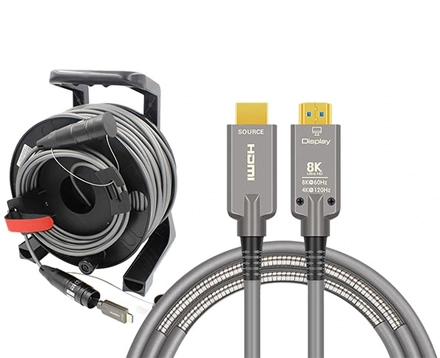
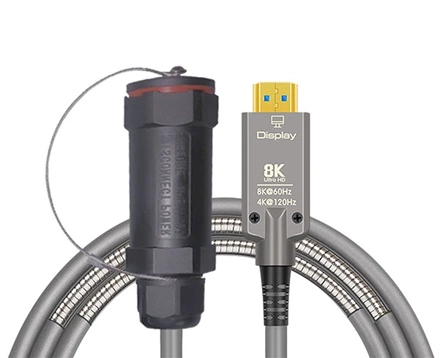
Fibre optic HDMI: Supports much longer transmission distances. Many high-end fibre optic HDMI cables can transmit signals over 200 meters. Our 8K pure fibre optic HDMI cable can transmit up to 500 meters (Pure Fiber Optic HDMI Extension Cable, AOC - AOCFiberLink), making it perfect for large-scale wiring needs.
Copper Cable HDMI: Copper cable HDMI works well over short distances. However, due to signal attenuation in electrical signals, it typically only supports effective transmission over distances of up to 10 meters. Beyond a certain distance, the signal quality will significantly degrade.
Fibre optic HDMI has a natural advantage when it comes to resistance to electromagnetic interference. Since it transmits light signals, it is not affected by external electromagnetic waves, ensuring high signal fidelity.
Fibre optic HDMI: Immune to electromagnetic interference, ensuring high-fidelity transmission of video and audio information, especially suitable for applications requiring high-quality signals. For example, the pure fibre optic HDMI 8K HDMI cables (Pure Fiber Optic HDMI Extension Cable, AOC - AOCFiberLink) are fully isolated from EMI interference, ensuring maximum signal transmission and fidelity.
Copper Cable HDMI: While copper cable HDMI performs well under normal conditions, in high-interference environments (such as near industrial equipment or large electronic devices), the signal may be affected by electromagnetic interference, leading to degradation in video and audio quality.
Copyright © Shenzhen Fiberlink Tech Co., Ltd. All Rights Reserved. Trusted Partners:https://www.aocfiberlink.com/