English
In professional AV and IT infrastructure, the connection isn't always a simple straight line from a laptop to a camera. Often, the signal must pass through patch panels, wall plates, or floor boxes.
Integrators frequently utilize Female-to-Female Keystone Couplers to create clean, accessible ports for end-users. However, this architecture creates a hidden challenge: connecting the hidden Host PC to the back of that patch panel.
Standard copper USB A-to-A cables fail miserably here. The combined insertion loss of the cable plus the coupler kills the signal.
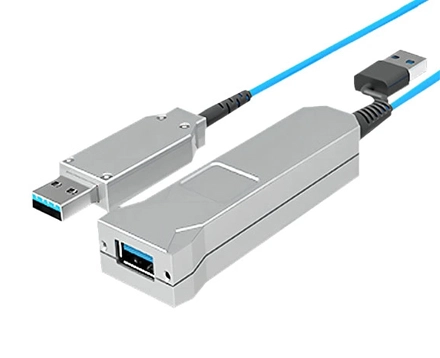
This is where the USB 3.2 AM to AM Fiber Active Optical Extension Cable becomes essential. It is the high-bandwidth "bridge" that ensures your structured cabling actually works at 10Gbps speeds.

The Scenario: You have a high-performance PC rack-mounted in a server closet. You need to provide a USB 3.2 access point on a wall plate 20 meters away in a conference room.
The Setup:
· Source: PC in the Rack.
· The Bridge: Our USB 3.2 AM-to-AM Fiber AOC running through the ceiling.
· The Interface: A USB 3.0 Female-Female Keystone Jack on the wall plate.
· The User: Plugs their device into the wall.
The Result: A seamless, professional finish with zero visible wires and full 10Gbps bandwidth.
Using couplers (Keystones) introduces "Insertion Loss." If you use a copper cable to reach the coupler, the signal is often too weak to jump across the connection to the user's device.
At AOCFiberlink, our Fiber AM-AM cable solves this physics problem:
· Signal Strength: Because optical fiber has virtually zero attenuation over distance, the signal arrives at the back of the wall plate with full integrity.
· Bandwidth: It supports the full USB 3.2 Gen 2 (10Gbps) standard, ensuring that even if the user plugs in a high-speed SSD or 4K webcam at the wall plate, it performs as if plugged directly into the motherboard.
· EMI Proofing: Running cables through walls often means running parallel to power lines. Our fiber core is immune to the electrical noise that plagues in-wall copper cabling.
Beyond structural cabling, the AM-to-AM configuration serves specific industrial needs:
· Non-Standard Equipment: Certain industrial enclosures, cooling systems, and proprietary data loggers utilize Type-A input ports. Our cable provides a direct, long-distance link to these devices.
· Data Transfer Bridges: Connecting specialized host-to-host data bridges (Note: requires specialized software/hardware bridge, not for direct PC-to-PC file transfer without isolation).
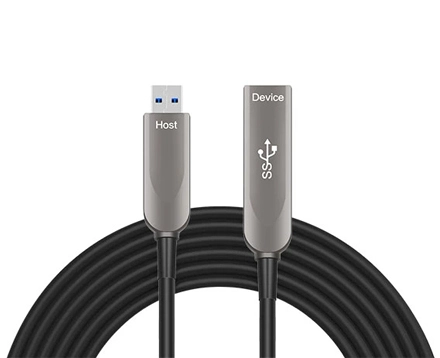
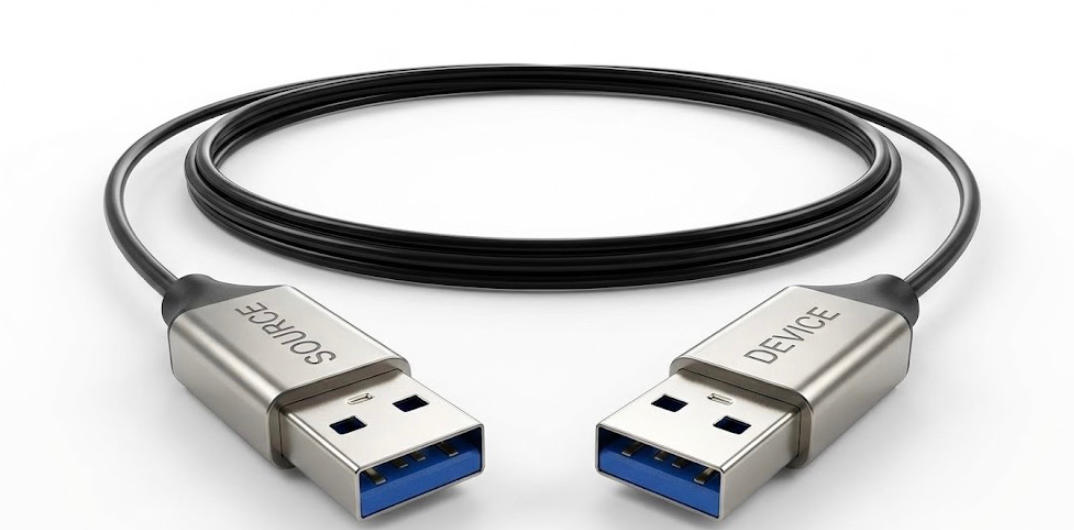
Unlike passive copper cables, Active Optical Cables are unidirectional.
· Source End (Host): Plugs into your PC or Server.
· Display/Device End: Plugs into the Patch Panel, Coupler, or Peripheral.
Installation Tip: Always check the connector labels before running the cable through the conduit!
Don't let a cheap copper cable behind the wall be the reason your expensive AV system fails. For structured cabling and patch panel integration, the USB 3.2 AM to AM Fiber AOC is the professional standard for "hidden" high-speed links.
Featured Product: USB 3.2 Type-A Male to Male Fiber AOC
· Interface: USB Type-A Male to USB Type-A Male.
· Speed: USB 3.2 Gen 2 (10Gbps).
· Ideal For: Patch Panels, Wall Plates, Keystone Couplers.
· Length: 10m - 50m (Customizable).
Copyright © Shenzhen Fiberlink Tech Co., Ltd. All Rights Reserved. Trusted Partners:https://www.aocfiberlink.com/