English
Modern display systems rely on three dominant video interfaces: USB-C, HDMI, and DisplayPort. None of them is universally "better"—each excels in different environments depending on bandwidth requirements, cable length, device ecosystem, and signal stability. As resolutions move toward 8K and beyond, traditional copper cables increasingly struggle, making HDMI AOC, DisplayPort AOC, and optical USB-C cables a critical part of real-world deployments.
This article examines USB-C, HDMI, and DisplayPort from a practical, industry perspective, with particular attention to how Active Optical Cable (AOC) technology reshapes their performance limits.
USB-C, HDMI, and DisplayPort define how video signals move between source devices and displays, but the interface standard alone does not determine real performance. Signal integrity, transmission distance, electromagnetic interference, and installation environment often become limiting factors long before protocol bandwidth is reached.
In professional AV, commercial display, medical imaging, industrial control, and high-end home cinema, HDMI active optical cable, DisplayPort AOC, and optical USB-C cable solutions are now widely used to overcome these constraints. Understanding how each interface behaves—both electrically and optically—is essential for correct system design.
The table below summarizes key technical characteristics relevant to modern deployments, including AOC compatibility.
| Feature | USB-C (DP Alt Mode) | HDMI | DisplayPort |
|---|---|---|---|
| Primary Function | Multi-protocol (data + video + power) | Consumer AV standard | PC & professional display |
| Max Bandwidth (Current) | Up to 40 Gbps (USB4 / DP Alt Mode) | 48 Gbps (HDMI 2.1) | 80 Gbps (DP 2.1) |
| Common Resolutions | 4K@60Hz, 8K (device-dependent) | 4K@120Hz, 8K@60Hz | 4K@240Hz, 8K@60Hz+ |
| Licensing | Open (USB-IF) | Licensed | Royalty-free |
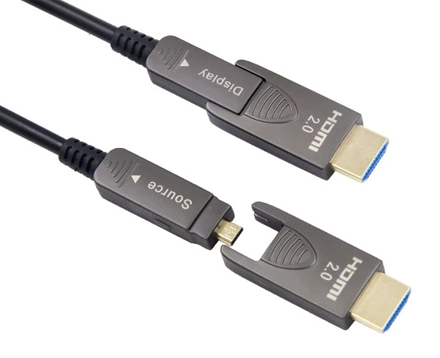
| Long-Distance Support | Optical USB-C cable | HDMI AOC | DisplayPort AOC |
| Typical Copper Limit | 1–2 m | 2–3 m | 2–3 m |
| Optical Cable Range | 10–50 m+ | 10–100 m | 10–100 m |
High bandwidth does not automatically translate into stable transmission. As data rates increase, copper cables suffer from attenuation, crosstalk, and EMI sensitivity. This is where HDMI AOC and DisplayPort AOC solutions become essential.
Active optical cables convert electrical signals into optical signals at the connector, allowing:
Stable transmission over long distances
Immunity to electromagnetic interference
Reduced cable diameter and weight
Consistent performance at full protocol bandwidth
HDMI remains the dominant interface for:
TVs and home theaters
Game consoles
Digital signage
Conference room AV systems
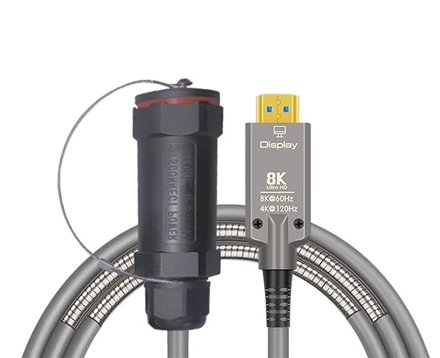
With the rise of 8K displays and large-format LED walls, HDMI active optical cable solutions are increasingly specified to ensure signal stability over long runs in commercial installations.
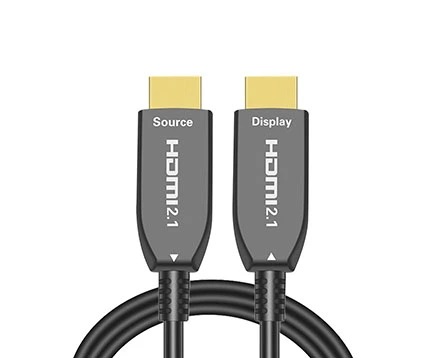
DisplayPort is widely adopted in:
High-refresh-rate gaming monitors
Professional graphics workstations
Multi-monitor setups
Industrial and medical imaging
DisplayPort AOC cables are commonly used where high resolution, high refresh rate, and long distance must coexist without signal degradation.
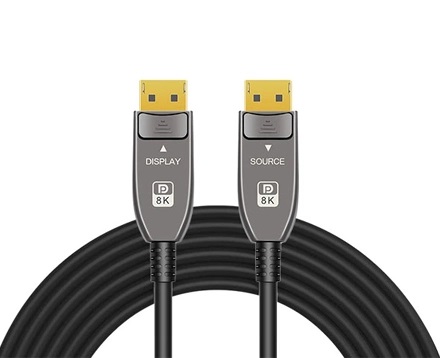
USB-C adoption continues to expand across:
Laptops and tablets
Docking stations
Portable monitors
Industrial embedded systems
An optical USB-C cable is particularly valuable when USB-C must carry video over distances beyond standard copper limitations, such as in control rooms or equipment racks.
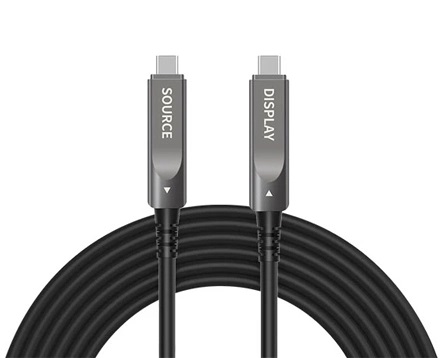
HDMI 2.1 fiber optic cable enables 8K video, but only when the cable can sustain 48 Gbps reliably. In installations exceeding a few meters, HDMI AOC becomes the practical solution for maintaining full resolution without artifacts or dropouts.
High refresh rates and low latency are critical. DisplayPort AOC cables allow esports arenas and training facilities to place PCs remotely while delivering uncompromised video performance to displays.
Factories, power plants, and traffic control centers often require long cable runs in electrically noisy environments. Optical USB-C cables and DisplayPort AOC solutions provide stable operation without EMI interference.
Diagnostic displays demand absolute signal integrity. Optical video cables ensure consistent image quality across long distances, making AOC solutions standard in many medical installations.
No. USB-C is a connector, not a guarantee of video support. Video transmission requires DisplayPort Alt Mode or USB4 support from both the source device and the cable. Optical USB-C cables must be designed specifically for video-enabled USB-C ports.
Key differences include:
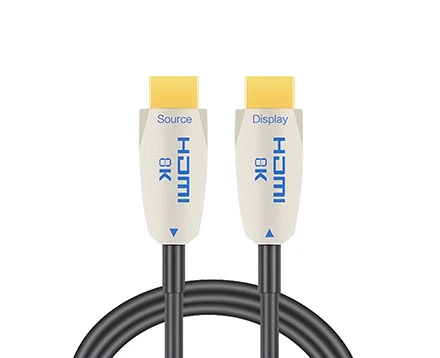
Directionality: Most AOC cables are directional and must be installed correctly
Power: AOCs draw power from the source device
Length: Optical cables support far longer distances
Cost: Higher than copper, but lower total system cost in complex installations
High-quality AOC cables are backward compatible with earlier HDMI and DisplayPort versions while remaining ready for higher-bandwidth applications. Proper chipset selection and optical engine design are critical for long-term reliability.
The move toward 8K, ultra-wide formats, and high-refresh displays will continue to push bandwidth requirements beyond what passive copper cables can reliably handle.
As costs decline and performance expectations rise, HDMI AOC, DisplayPort AOC, and optical USB-C cable solutions are transitioning from niche products to mainstream infrastructure components.
Optical cables reduce the need for signal boosters, repeaters, and extenders, simplifying system architecture and lowering maintenance risks—an important factor in large-scale commercial projects.
HDMI and DisplayPort both support 8K, but practical performance depends on cable quality and distance. For long runs, HDMI AOC and DisplayPort AOC provide more reliable results than copper cables.
USB-C integrates video, data, and power, but it does not fully replace HDMI or DisplayPort in all scenarios. Dedicated video interfaces remain essential for high-performance and long-distance applications.
Active optical cables are recommended when cable length exceeds standard copper limits, when EMI immunity is required, or when maximum resolution and refresh rate must be guaranteed.
Yes. Industrial-grade HDMI AOC and DisplayPort AOC cables are widely used in permanent AV, broadcast, and industrial installations due to their stability and longevity.
Well-designed AOC solutions are built with bandwidth headroom, allowing them to support upcoming protocol updates within the same interface generation.
USB-C, HDMI, and DisplayPort will continue to coexist, each serving distinct markets and applications. What is changing rapidly is the cable layer. As performance demands rise, active optical cable technology is becoming essential for delivering the full potential of modern video interfaces—reliably, over distance, and at scale.
For system designers, integrators, and buyers, understanding this shift is no longer optional—it is central to building future-ready display solutions.
Copyright © Shenzhen Fiberlink Tech Co., Ltd. All Rights Reserved. Trusted Partners:https://www.aocfiberlink.com/