English
DisplayPort 2.0 represents a major breakthrough in connectivity standards, ushering in a new era of high-bandwidth transmission and enabling higher resolution video, higher refresh rates, and unprecedented HDR detail. However, not all DisplayPort 2.0 devices are created equal. Like previous generations of DisplayPort, DP 2.0 offers multiple transmission modes with varying bandwidth capabilities. Only specific devices and specific DisplayPort cables support the most powerful transmission mode.
DisplayPort 2.0 will use the same DisplayPort interface and ports as previous DisplayPort standards, but will also offer USB-C and Thunderbolt connectivity via DisplayPort Alt Mode over USB. This brings significant bandwidth improvements, support for new resolutions and refresh rates, new features, and improved support for different connectors. Similar to DP Alt Mode in previous DisplayPort standards, this version allows audio, video, and data to be transmitted over a single USB cable, facilitating connections to compatible displays. This is particularly useful when connecting external displays to laptops with limited port options, or for cascading multiple displays.
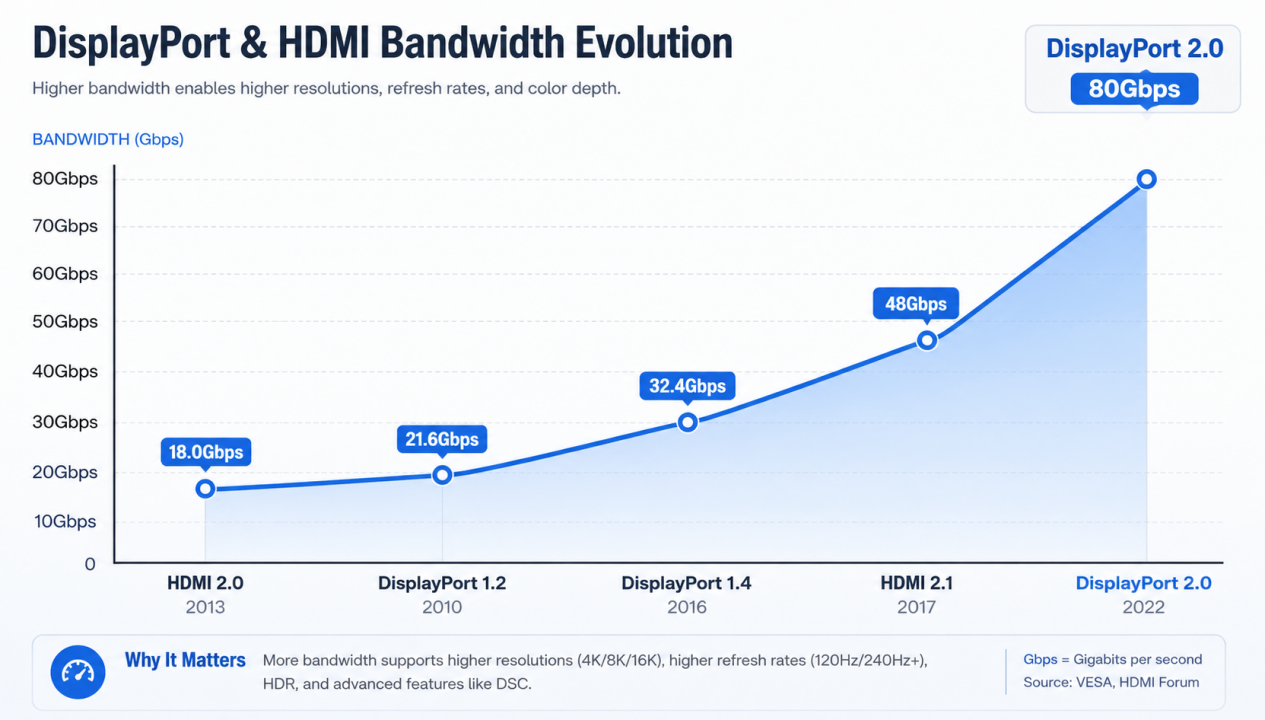
The most prominent feature of DisplayPort 2.0 is its significant increase in overall bandwidth. DisplayPort 1.4 offers a maximum bandwidth of 32.4 Gbps (with a maximum data rate of 25.92 Gbps due to low encoding efficiency), while DisplayPort 2.0 offers more than twice that bandwidth. Its maximum total bandwidth reaches an astonishing 80 Gbps (with a maximum total data rate of 77.37 Gbps).
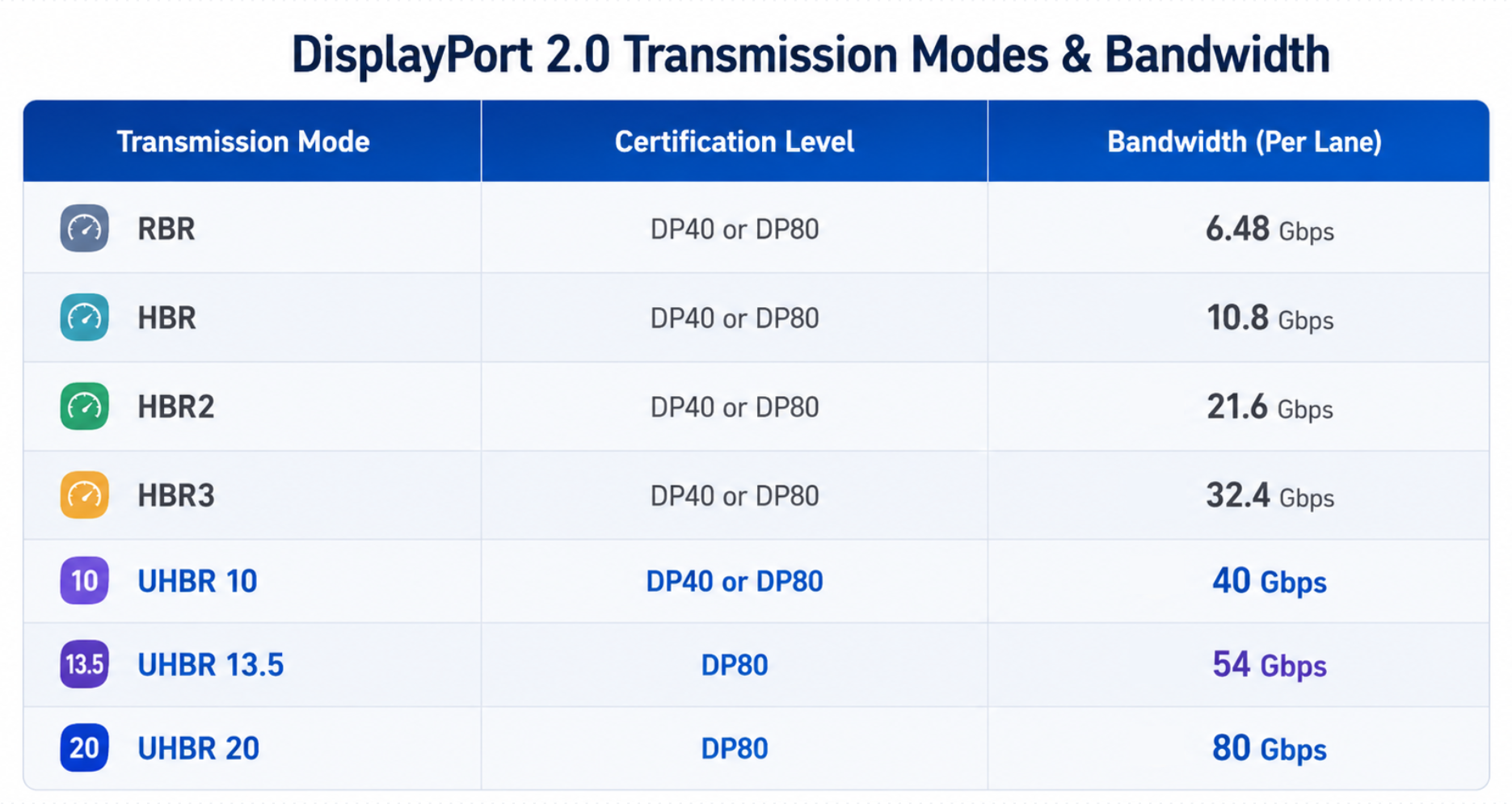
In addition to Lower Bit Rate (RBR), High Bit Rate (HBR), High Bit Rate 2 (HBR2), and High Bit Rate 3 (HBR3), DisplayPort 2.0 also introduces Ultra High Bit Rate 10 (UHBR 10), Ultra High Bit Rate 13.5 (UHBR 13.5), and Ultra High Bit Rate 20 (UHBR 20).
The new modes offer 10 Gigabits, 13.5 Gigabits, and 20 Gigabits per lane. With a standard DisplayPort 2.0 cable offering four lanes in each cable, the maximum bandwidth of the new modes will be 40 Gbps, 54 Gbps, and 80 Gbps, respectively, with a few gigabits per second shaved off to account for encoding inefficiencies (hence the lower overall max data rate for each transmission mode).
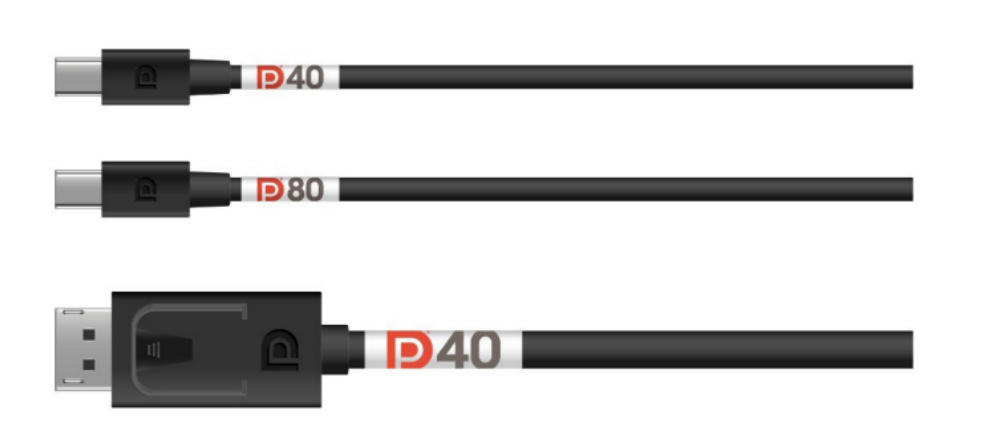
Not all DisplayPort 2.0 cables support all the new transmission modes; some cables only support UHBR 10, while others support the full UHBR 20. The Video Electronics Standards Association (VESA) has certified two clear cable standards that you can refer to when purchasing DP 2.0 cables: DP40 and DP80.
But what is DP40, and what is DP80, when it comes down to it?
Certified DP40 cables support all modes, including UHBR 10, with a maximum bandwidth of 40 Gbps. DP80 cables support all seven DisplayPort transmission modes, including the highest bandwidth UHBR 13.5 and UHBR 20, with a maximum bandwidth of 80 Gbps.
A key feature of DisplayPort 2.0 is support for DSC 1.2a. This enables higher resolution and refresh rate support, potentially unlocking a single 16K display at 60Hz with HDR enabled, or three 10K displays at 60Hz. When simultaneously transmitting data and video via USB-C using DP Alt Mode, a DP80 certified cable should still be able to output to three 144Hz 4K displays with HDR enabled.
The best DisplayPort 2.0 cables are always those that are officially VESA certified. By meeting VESA's stringent standards, they offer the highest quality cabling, guaranteeing excellent picture and audio quality with no signal attenuation, and you have an ironclad guarantee that they will deliver on their claimed bandwidth capabilities.
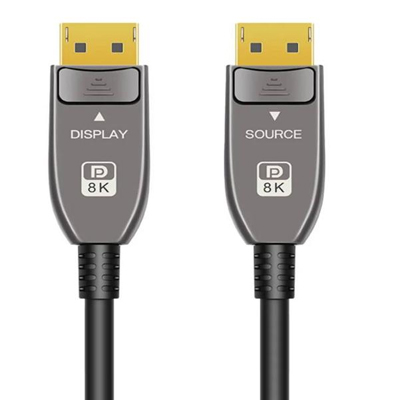
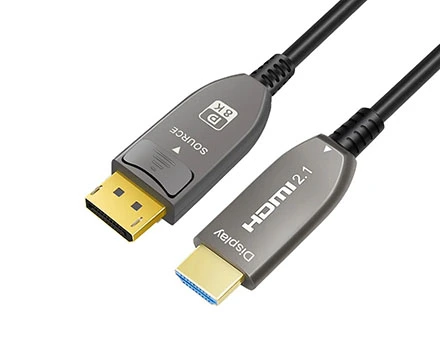
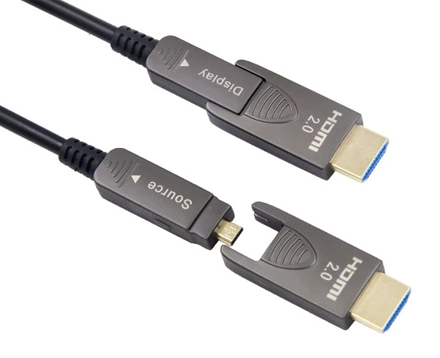
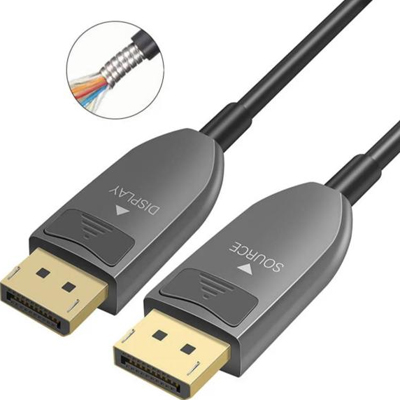
If you're looking for a truly high-performance cable compliant with the DP 2.0 standard, the 8K HDMI AOC Active Fiber DisplayPort 2.0 Cable is worth considering.
This product is VESA certified and supports the UHBR13.5 specification, delivering up to 54Gbps of bandwidth.Compliant with DisplayPort 2.1 specification and Supports 8K@60Hz, HBR3, HDCP 1.4/2.3. Let's take a look at its advantages compared to ordinary DP cables:
Transmission performance:
Fiber-optic DP2.0 cables use optical signal transmission,and have a maximum bandwidth of 54Gbps. Its ultra-high speed makes it ideal for processing high-resolution video, large-capacity data transmission, and high-speed storage devices.
Transmission distance:
Our fiber optic DP cable 2.1 can easily achieve signal attenuation-free transmission over hundreds of meters, and its remote performance is particularly critical for scenarios requiring remote connectivity, such as conference rooms and large data centers.
Anti-interference ability:
Fiber optic transmission is immune to EMI and RFI, ensuring highly stable signal performance. It is ideal for medical equipment, industrial environments, and professional video production.
|  |
In summary, DisplayPort 2.1 optical cables offer significant advantages over traditional copper DP cables in bandwidth, transmission distance, and signal stability. With VESA certification, UHBR13.5 support, and up to 54Gbps bandwidth, our 8KHDMIAOC fiber optic DP2.1 cable is built for next-generation displays and professional AV applications, delivering a faster, more stable, and future-ready connectivity solution.Additionally, we offer customizable cable lengths to meet different installation requirements, along with factory-direct OEM/ODM support featuring fast delivery and no minimum order quantity, providing flexible solutions for both commercial projects and brand partners.
If you are interested, please feel free to contact us.
Copyright © Shenzhen Fiberlink Tech Co., Ltd. All Rights Reserved. Trusted Partners:https://www.aocfiberlink.com/