English
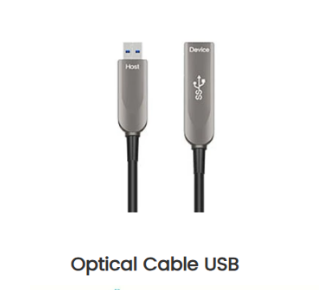
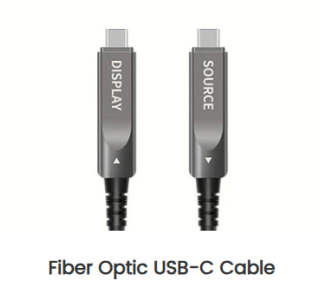
AOC is an abbreviation for "Active Optical Cable". The idea behind this design is to convert high-speed digital signals (such as HDMI/DP/USB) into optical signals, because traditional copper cables are limited in transmission distance due to their natural physical properties.
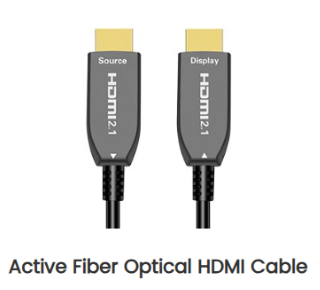
Fiber optic HDMI cables use the same HDMI protocol as standard HDMI cables, but employ a different construction method to create a more powerful cable. Fiber optic HDMI cables use glass optical fibers to transmit data at the speed of light, allowing HDMI cables to support longer distances and providing better resistance to external EMI/RFI.
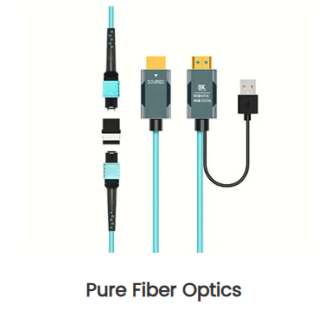
Standard HDMI cables consist of multiple pairs of twisted copper wires, insulated and protected, and wrapped in shielding and silicone. Fiber optic HDMI cables, however, eliminate the central twisted copper wires but retain the copper control circuitry. At their core are four glass optical fibers, encased in a protective coating. These glass fibers transmit data in the form of light pulses, rather than electrical current.
These glass optical fibers are surrounded by seven to nine pairs of twisted copper wires, which are responsible for the power supply of the cable, one pair for consumer electronics control (CEC), two pairs for audio feedback (ARC and eARC), and one pair for display data channel (DDC) signals.
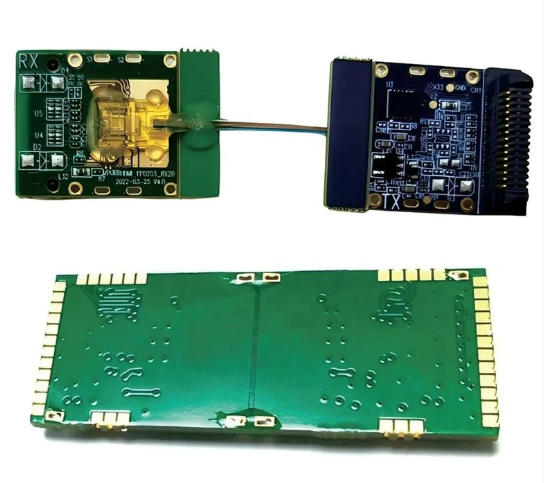
Fiber optic cables, because they use light instead of electricity to transmit data, are significantly less sensitive to signal interference, noise, and crosstalk. Each end has a converter, enabling the source end to convert electrical signals into optical signals for data transmission, while the display end converts optical signals back into electrical signals. All fiber optic HDMI AOC are active, meaning they operate in only one direction.
Fiber optic HDMI cables offer several advantages over traditional copper stranded HDMI cables. The first and most significant is their available length. Fiber optic HDMI cables experience far less interference and minimal signal attenuation along the cable, allowing for considerably longer lengths. Standard twisted copper HDMI cables reached up to 30 feet in some generations—but passive HDMI 2.1 cables were closer to 9 feet—while fiber optic HDMI cables can extend to 1000 feet or more.
This makes fiber optic HDMI cables an ideal solution for covering long-distance displays such as billboards, bar TVs, and storefront displays, where traditional HDMI cables cannot cover or transmit high-resolution images.
Fiber optic cables are not only more robust but also provide extensive shielding against electromagnetic interference, noise, and crosstalk—more so than any copper HDMI cable. This makes them an excellent solution for professional or enterprise environments, where the sanctity of video transmission is paramount.
The latest generation of fiber optic HDMI cables fully supports 4K and 8K resolutions, such as 8K fiber optic HDMI cable, along with high refresh rates, HDR, and eARC support (significantly better than fiber optic cables). While higher resolution and refresh rate displays are not currently available, theoretically, the HDMI 2.1 standard can support up to 10K resolution at 120Hz when using display stream compression and chroma subsampling.
The first factor to consider is the HDMI version. With HDMI 2.2 only recently introduced, the price difference between Fiber Optic HDMI 2.1 and 2.0 cables is now relatively small. Since HDMI is backward compatible, choosing an HDMI AOC is often the more future-proof option. Using the latest generation HDMI 2.1 will give you access to all the features and optimal performance of HDMI-enabled devices. Most importantly, when purchasing fiber HDMI cables, always check if the vendor has HDMI Association certification.
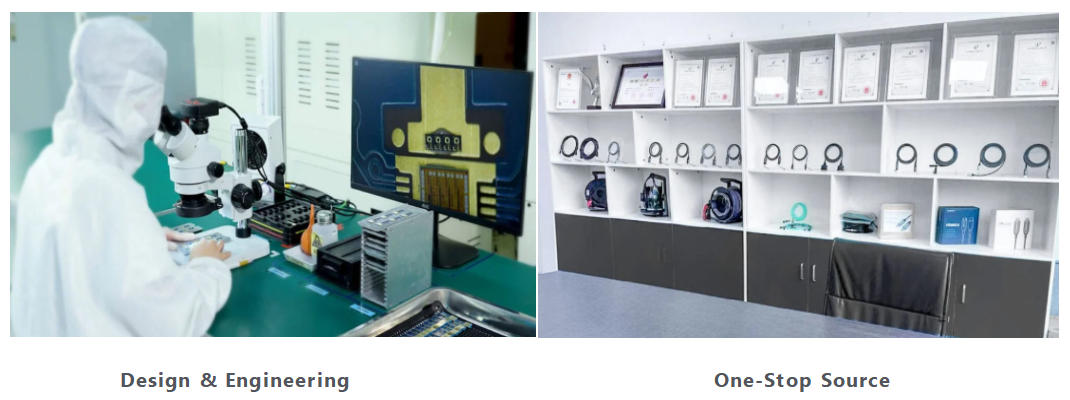
Here, we recommend 8KHDMIAOC. Our cables are all HDMI Association certified. We prioritize the quality and reliability of our fiber optic cables, rigorously testing them during R&D, pilot production, and manufacturing to ensure superior performance and reliability.
|  |
 |  |
Copyright © Shenzhen Fiberlink Tech Co., Ltd. All Rights Reserved. Trusted Partners:https://www.aocfiberlink.com/